
1. Design a counter with output sequence 14, 15, 0, 7, 8, 9, 5,
6 in a wrap around fashion with a modulo16 counter and a
minimal number of 4:1 multiplexers.
2.A Full Subtracter inputs three bits: bit x, subtrahend y, borrowin bit bin, and outputs two bits: difference d, borrowout bit bout. Implement the Full Subtracter with a minimal twolevel NAND gates.


3.Design a fourbit borrowlookahead subtracter with four Full Subtracters and a minimal network of AND, OR, NOT gates.
In general:
and
Let Gi = xi'yi and Pi = xi' + yi
then
solving for each bi
b1 = G0 + P0b0
b2 = G1 + P1b1 = G1 + P1(G0 + P0b0) = G1 + P1G0 + P1P0b0
b3 = G2 + P2b2 = G2 + P2(G1 + P1G0 + P1P0b0) = G2 + P2G1 + P2P1G0 + P2P1P0b0
b4 = G3 + P3b3 = G3 + P3(G2 + P2G1 + P2P1G0 + P2P1P0b0) = G3 + P3G2 + P3P2G1 + P3P2P1G0 + P3P2P1P0b0
Finally, using the subtractors from problem 2:
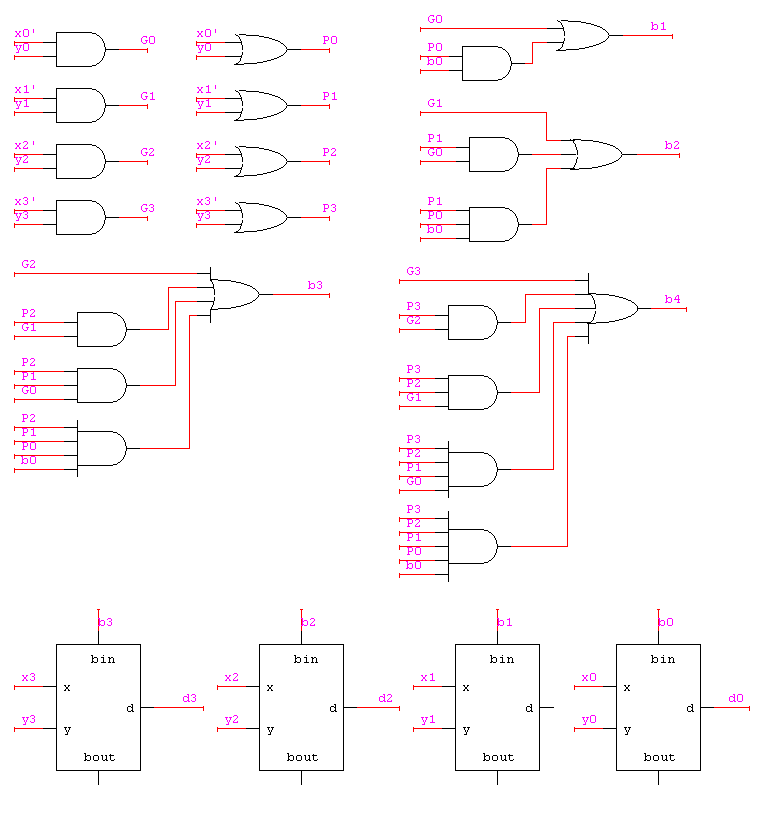
4.A serial subtracter inputs xi, yi, the i'th bit of two binary numbers in each clock cycle for i = 0 to n and outputs the difference. Implement the subtracter with a JK FlipFlop and a minimal network of AND, OR, NOT gates.
(Q) | (Qnext) | ||||||
|---|---|---|---|---|---|---|---|

