CSE 120 Winter 2001 Project 2
Due 27 February 2001
Overview
Problem Summary
In Unix, the standard unit of multitasking is the process: a single thread
of control in its own address space. A Unix process is a fairly heavy-weight
object; to switch from one process to another can require the system to
shuffle a large amount of information around. In some applications, it
is more useful to have the unit of multitasking be a more light-weight
object. This can be achieved by having several threads of control running
within one address space: all of them share the same global variables,
open files, etc.
Your assignment is to implement a simple version of this capability.
The threads will communicate by waiting on conditions and signalling on
these conditions. When a thread is signalled, it is passed a value which
may contain some data.
Context Switching
Although your threads share a single address space, they have separate
stacks and register states. We call this private information the context
of a thread.
One needs a way to be able to switch from one thread context to another;
i.e.
when a thread yields or blocks on a condition, another thread should start
running. We will use the C functions setjmp and longjmp
for this purpose.
The manual page for setjmp and longjmp are on sdcc7;
please look there for details. Briefly, setjmp saves the current
context (stack and registers) of a C program in a jmp_buf type.
longjmp
takes a jmpbuf argument and restores the context. So when a thread
yields or blocks, it will save its context via setjmp, and then
a scheduler can start a new thread via longjmp. Read on for further
details.
Conditions
You will implement a generalization of pure conditions, which have some
properties of both pure conditions and semaphores. You should call this
type Condition in your project. There are two basic operations
associated with conditions:
-
A thread can wait on a condition. If there are no queued signals
on that condition (see below), then the thread blocks until the condition
is signaled by a later thread. If there is at least one queued signal for
that condition, then the thread is returned one signal value, and continues
execution.
-
A thread can signal a condition. If there are threads waiting on
the condition, only one of the blocked threads is woken up (``unblocked'')
by the signal. If there are no waiting threads, the signal might be thrown
away, or queued for the next thread that waits on this condition. (You
will implement both behaviors.)
Every signal has associated with it a parameter, of type any_ptr,
that will be passed to the thread woken up by the signal. Signal parameters
have a variety of uses depending on the application program. They can be
useful for testing your threads package, too. If you don't care about the
parameter for a particular signal, just send NULL.
Standard Headers
You are provided with two standard header files, called /users/cs120w/p2/{standard.h,thread.h},
which you should #include unchanged in your program. The first
header file provides the following definitions:
-
any_ptr: This type is useful for managing objects whose type you
don't want to declare. Any kind of pointer; for example, (char *), (int
*), etc., can be cast to an any_ptr, and vice versa.
-
Boolean: This type can have two values, TRUE (1) and FALSE (0).
-
ThreadFunc: A pointer to a void function, that takes
one argument of type any_ptr. You will use this type to hold the
initial routine a thread enters when it is created.
The second header file provides the definitions for your threads package,
described below.
Needed Data Abstractions
-
A queue manager. This should be able to maintain a queue of arbitrary objects.
You should be able to create a new queue, destroy a queue, insert a value
at the end of a queue, return the first object from a queue, and determine
(nondestructively) whether or not a queue contains any elements.
-
Some structure to hold information about a thread. This will probably contain
at least a jmp_buf holding the thread context. It might contain
other fields as well.
-
A type, Condition, implementing a condition variable. The type
signature for this is in thread.h, and must be a pointer to a
struct containing (at least) two queues: a queue of threads that are blocked
awaiting signals, and a queue of signals that are awaiting threads to receive
them.
-
A global ``ready queue'' which contains pointers to the contexts of all
threads which are ready (i.e. not blocked on any condition and not running.)
Needed Routines
At the minimum you must write the routines described below. Their type
signatures are defined in thread.h.
void t_start(ThreadFunc f, any_ptr v)
You have to bootstrap the system before you can start creating threads.
Normally, t_fork is called by one thread to create another thread.
Initially, however, there are no threads; t_start is responsible
for creating the first thread. The first thread may be one that is responsible
for creating other threads, and can be created in a special manner (whatever
your particular setup requires).
t_start should start all threads which your system requires
internally, and should then start a thread executing the user's routine
f
with parameter v.
t_start does not return until all the user's threads have exited
or blocked (if all are blocked, the system is deadlocked). It should set
up a jmp_buf which will be longjmp'd to when deadlock
is detected, or when the last thread exits. In addition, it should be possible
for the main program to call t_start repeatedly.
Condition cond_create()
This routine returns a newly allocated condition, with two queues allocated
for blocked threads and pending signals.
Boolean cond_is_empty(Condition cond)
Given a condition, this routine returns FALSE if some thread is
blocked awaiting a signal on that condition, and TRUE if no thread
is blocked on that condition.
void cond_destroy(Condition cond)
This routine destroys the condition, freeing up any memory allocated for
it and its parts. After this function, cond is no longer a valid
condition.
void t_yield()
This routine places the current thread on the ready queue, allowing another
thread to run. It has no effect if there are no other threads on the ready
queue.
any_ptr t_wait(Condition cond)
The calling thread blocks, waiting for some other thread to signal the
condition (using t_sig below). Note that the context switches
without t_wait returning. When this thread wakes up, t_wait
returns the value that the signalling thread passed to the t_sig
call (see below). If several threads wait on the same condition, they are
woken up, one per signal, in FIFO order. If there are pending unreceived
signals on the condition, the thread will not block, but will take the
oldest unreceived signal ( i.e. , FIFO order again). The chronology
of a call is:
-
Check the pending signal queue.
-
If it is not empty, dequeue the first value and return it. Nothing more
needs to be done.
-
If it is empty, the thread must wait to be signalled:
-
Check the ready threads queue.
-
If it is empty, the system has deadlocked, and the program should exit.
-
If it is not empty, this thread must block itself and start up the first
thread on the ready queue:
-
Update the context part of your thread information structure (using setjmp),
and add the thread structure to the condition's blocked queue.
-
Dequeue the first thread from the runnable queue and longjmp to
its context. This will cause it to resume execution where it was suspended.
-
Eventually the blocked thread will receive a signal and be rescheduled
to run. When this happens, it must find out the value of the signal that
awoke it and return this value.
void t_sig(Condition cond, any_ptr val, Boolean queue_signal)
A condition cond has been signalled. val is an optional
parameter that will be passed to the thread awoken by the condition. If
a thread is currently blocked on the condition, it should be woken up and
made ready to run. This process will be inside t_wait, and so
that function will return val.
If no thread is blocked on the condition, what action is taken will
depend on the queue_signal parameter. If queue_signal
is TRUE, the signal info (including at least the parameter val)
gets added to a ``pending signals'' queue of the condition, with the assumption
that some future thread will block on the condition. If queue_signal
is FALSE, the signal and parameter val are simply discarded.
The former behavior resembles that of a semaphore, while the latter emulates
a pure condition.
void t_fork(ThreadFunc f, any_ptr v)
This routine performs a ``fork'': it splits one thread into two. The first
one continues as though the call did nothing; the second one begins executing
routine f with parameter v.
Note: In the following we use the convention that stacks grow down;
i.e.,
the place where stack expansion takes place is the bottom of the stack.
The new thread must have some stack space allocated for it. There are
several ways to do this. One way that is in some senses cleaner than most
others involves having a special ``spawner'' thread that is signalled by
the t_fork routine. This thread lives below all allocated stack
space that is in use by other threads, and is generally waiting on a special
internal condition. When it is signalled, it performs the following sequence
of operations:
-
Allocate some space for the new thread's context.
-
From the value of the signal that awoke it (the return value from t_wait),
get the routine and parameter for the new thread.
-
Call setjmp (this will be where the new thread begins executing).
-
Append this new context to the runnable threads queue.
-
Call the spawn routine recursively, via some intermediate routine
with a large amount of locals (a large local array will do). This causes
a block of stack space to be allocated. This space will be the stack for
the new thread; as the new thread's stack grows down, it will not run into
any other thread's stack (unless it overflows the space allocated for it;
you should make this space large enough that this will not be a problem
for the code that you write; 10000 bytes is usually far more than enough).
-
This recursive call must never return. If it does, it will suddenly
be executing with its stack pointer in the same area as the new thread's
stack pointer; this will cause nothing but grief.
-
Once the spawn routine has successfully recursed, it again waits on the
spawn condition, waiting for another thread to fork.
-
The context created by the setjmp call above, that was originally
placed on the runnable threads queue, will eventually start running. When
it does, it should call the user's routine, with the supplied argument.
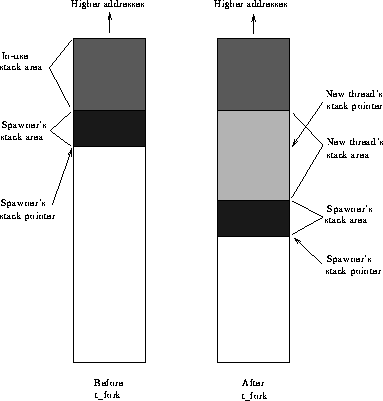
Figure: Stack configurations around
a t_fork
The above figure shows how the stack is changed by the execution of
a t_fork. Initially, there is some amount of stack in use by active
threads. The spawner's stack space is below all other threads' stack space.
When the spawner receives a signal, it first does a setjmp to
its current position; this is where the new thread's stack pointer will
begin. It then copies itself down the stack, through a recursive call (explained
below), and blocks on its condition again. Note that its old stack area
is now the property of the new thread; it may never return from the recursive
call because this would cause it to try to use its old stack area, causing
a conflict. The new thread's stack pointer is now where the spawner's stack
pointer used to be; the spawner's old locals can now be used by the new
thread (since, until it calls the user's code, it is still executing in
the spawn routine).
The stack space should be allocated by using indirect recursion: the
routine where the spawner normally waits for a signal should call another
routine, which has a large local array, which calls the first routine again.
The reason for this is that the stack pointer is at the bottom of the local
space, and so the top of the next routine's locals will be just below this.
If this next routine is the spawn routine again, some of its locals (the
ones at the top of its area) may be overwritten by the new thread. Interposing
a separate routine which does nothing but allocate stack space solves this
problem.
Note that, as you have multiple threads active, you have multiple stack
areas. Your thread switching routines will be jumping back and forth between
them using longjmp.
Thread Exiting
The way that a thread exits is by returning from the routine where it began
executing: that is, the routine passed to the call to t_fork that
created it. Your code must anticipate threads exiting this way and handle
them correctly. You may want to have the thread queue itself on some condition
that will never be signalled, or have it simply overwrite its own context
with that of another runnable thread.
Testing
We will link a test program to your module(s) to test the required operations.
That is why we have provided you with the definitions in thread.h:
by including this header file, we will be able to test your package.
The test module, which includes main(), will be available for
public use in two weeks. When you hand in your program, your makefile will
link your modules with our test module to create an executable. (See Turning
In.)
Documentation
You should hand in a Design Document with your project. There is
no official minimum or maximum size, but I am expecting something around
three to five pages long.
Spend some time thinking how to structure this document. Think of the
design document as being the paper that you'd want someone to read who
is familiar with thread.h but not with your implementation. This is the
place to describe any assumptions that you made (and, why you made them)
and the ramifications of those assumptions. If you think that it would
describe your package well, you might sketch out a typical execution path.
This is also the place to mention any known bugs.
Note that the proper use of English and a coherent writing style is
important in writing this document.
Turning In
The completed project must be submitted via e-mail to the account cs120w
on sdcc7. This message must contain a uuencoded tar file with
no directory structure. The due date is 11:59 PM on Tuesday, 27 February
2001.
The tar file should include a make file (titled makefile) set
up such that the command `` make'' will create an executable file
thread
that we can run. Your executable will be the combination of your .c
files and our test module (we provide the main()). Again, our
test module will be available in two weeks; watch discus.ucsd.edu
for details.
Grading
The grade for this assignment will be computed as follows:
-
Documentation 25%, described above.
-
Correctness 40%: whether your program successfully does what was stated
in the assignment handout and your problem specification. Bugs or logic
errors found by our testing programs, or by code inspection, will lower
this grade.
-
Readability 20%: the degree to which your program can be read and understood
by another. Good commenting is one factor, especially at the top of modules
and functions. However, also remember that too many comments (e.g. one
for every line!) can severely crowd a program. The code should go a long
way in explaining itself: via intelligent function and variable naming,
modular design, and intuitive rather than hacked-up algorithms.
-
Elegance 15%: the quality of your programming solutions. This can mean
good, tight algorithms; function re-use; economic utilization of memory;
and enhanced performance through optimization. Note that none of these
should be pursued in a way that greatly sacrifices readability. You won't
lose many points here as long as you are not overly wasteful or sloppy
in your code.
We will accept late projects, but they will be docked 15% of the total
points per day.