% CSE 130: Fall 2014
% Iteration & Recursion (Continued)
% Ranjit Jhala, UC San Diego
## News
- [HW #6](http://cseweb.ucsd.edu/classes/sp14/cse130-a/homeworks/hw6.html), due Sun 6/8 by 11:59pm
## Recap: Scala Basics
- Expressions, Values, Types
- Functions
- Collections
## Today: Finish Iteration AND Recursion
Elegant way to *systematically*
1. Generate Combinations
2. **Search Combinations**
3. Generate & Search Combinations
## QUIZ: Systematic Search/Query
~~~~~{.scala}
val res = for (i <- 1 to 10;
j <- 1 to 10;
k <- 1 to 10
if i*i + j*j == k*k)
yield (i, j, k)
~~~~~
What is the **value** of `res` ?
**A.** `Vector()`
**B.** `Vector((3,4,5), (6,8,10))`
**C.** `Vector((6,8,10), (3,4,5))`
**D.** `Vector((3,4,5), (4,3,5), (6,8,10), (8,6,10))`
**E.** `Vector((8,6,10), (6,8,10), (4,3,5), (3,4,5))`
## Systematic Search/Query
~~~~~{.scala}
val res = for (i <- 1 to 10;
j <- 1 to 10;
k <- 1 to 10
if i*i + j*j == k*k)
yield (i, j, k)
~~~~~
Is equivalent to:
~~~~~{.scala}
val res = (for (i <- 1 to 10;j <- 1 to 10; k <- 1 to 10)
yield (i, j, k)
).filter((i, j, k) => i*i + j*j == k*k)
~~~~~
which is equivalent to:
~~~~~{.scala}
Vector( (1,1,1), (1,1,2), ..., (1,1,10), (1,2,1),..., (1,10,10)
, (2,1,1), (2,1,2), ..., (2,1,10), (2,2,1),..., (2,10,10)
, ...,
,(10,1,1), (10,1,2),...,(10,1,10), (10,2,1),...,(10,10,10)
).filter((i, j, k) => i*i + j*j == k*k)
~~~~~
## Systematic Search/Query
### Note: `filter` Preserves Sequence Order
Hence, the expression
~~~~~{.scala}
Vector( (1,1,1), (1,1,2), ..., (1,1,10), (1,2,1),..., (1,10,10)
, (2,1,1), (2,1,2), ..., (2,1,10), (2,2,1),..., (2,10,10)
, ...,
,(10,1,1), (10,1,2),...,(10,1,10), (10,2,1),...,(10,10,10)
).filter((i, j, k) => i*i + j*j == k*k)
~~~~~
evaluates to ...
**D.** `Vector((3,4,5), (4,3,5), (6,8,10), (8,6,10))`
>- How would you **avoid** duplicates?
# Can Query More Interesting Objects
# Brief Digression: Case Classes
## Case Classes
~~~~~{.scala}
case class Name(x1: T1, x2: T2, ..., xn: TN)
~~~~~
Creates a class `Name` with
> 1. **Immutable** fields `x1` of type `T1` ... `xn` of type `Tn`
> 2. **Constructor** method for object creation
> 3. **Extractor** method for *pattern matching* (later...)
## Case Classes: Example `Novel`
Here is a case class (just fancy records for now...)
~~~~~{.scala}
case class Novel(title: String, author: String)
~~~~~
You can create **instances** thus (no need for `new`)
~~~~~{.scala}
scala> val n1 = Novel ("A Feast For Crows", "George R. R. Martin")
n1: Novel = Novel(A Feast For Crows,George R. R. Martin)
~~~~~
and access **fields** like so
~~~~~{.scala}
scala> n1.author
n1: String = George R. R. Martin
~~~~~
## Case Classes: Example `Novel`
Here is another case class (just fancy records for now...)
~~~~~{.scala}
case class Album(title: String, artist: String)
~~~~~
You can create **instances** thus (no need for `new`)
~~~~~{.scala}
scala> val a = Album("We are glitter", "Goldfrapp")
a: Album = Album(We are glitter,Goldfrapp)
~~~~~
# Back to Querying More Interesting Objects
## Database Style Queries
Suppose we have a "database" of `novels`
~~~~~{.scala}
val novels =
List( Novel ( "Skinny Legs and All"
, "Tom Robbins")
, Novel ( "Breakfast of Champions"
, "Kurt Vonnegut")
, Novel ( "An Object of Beauty"
, "Steve Martin")
, Novel ( "Sophie's Choice"
, "William Styron")
, Novel ( "The Other"
, "Tom Tryon")
)
~~~~~
## Database Style Queries
... and a "database" of `albums`
~~~~~{.scala}
val albums =
List( Album ( "Rare Bird Alert"
, "Steve Martin")
, Album ( "Paper Airplane"
, "Alison Krauss and Union Station")
, Album ( "Earl Scruggs and Friends"
, "Earl Scruggs")
)
~~~~~
## Database Style Queries
... and a "database" of `movies`
~~~~~{.scala}
val movies =
List( Movie ("Airplane",
List ( "Leslie Nielsen", "Robert Stack"))
, Movie ("Young Frankenstein",
List ("Gene Wilder", "Madeline Kahn"))
, Movie ("The Pink Panther",
List ("Steve Martin", "Jean Reno"))
)
~~~~~
## Query: Is there `tripleThreat` ?
A person who has
> 1. **written** a book,
> 2. **acted** in a movie,
> 3. **performed** in an album ?
## Query: Is there a `tripleThreat` ?
A person who has
1. **written** a book,
2. **acted** in a movie,
3. **performed** in an album ?
Cue, nested loop query...
~~~~~{.scala}
for (n <- novels;
a <- albums;
m <- movies;
if (n.author == a.artist && m.actors.contains (n.author)))
yield (n.author)
~~~~~
## Query: Is there a `tripleThreat` ?
A person who has
1. **written** a book,
2. **acted** in a movie,
3. **performed** in an album ?
Cue, nested loop query...
~~~~~{.scala}
for (n <- novels;
a <- albums;
m <- movies;
if (n.author == a.artist && m.actors.contains (n.author)))
yield (n.author)
~~~~~
Which evaluates to
~~~~~{.scala}
tripleThreats: List[String] = List(Steve Martin)
~~~~~
>- Not necessarily very efficient of course ...
## Even more magical: From Loops-to-SQL
You can define a special collection type such that the expression
~~~~~{.scala}
for (n <- novels;
a <- albums;
m <- movies;
if (n.author == a.artist && m.actors.contains (n.author)))
yield (n.author)
~~~~~
is **automatically** converted into an SQL (DataBase) query ...!
>- [ScalaQL](http://jiangxi.cs.uwm.edu/publication/sle09.pdf)
>- [.NET LINQ](http://en.wikipedia.org/wiki/Language_Integrated_Query)
>- [Monad Comprehensions](http://homepages.inf.ed.ac.uk/wadler/papers/monads/monads.ps)
>- Not on final...
## Today: Iteration AND Recursion
Elegant way to *systematically*
1. Generate Combinations
2. Search Combinations
3. **Generate & Search Combinations**
# Iteration + Recursion + Filter = Fun Ensues
## Generate and Search: The N-Queens Puzzle
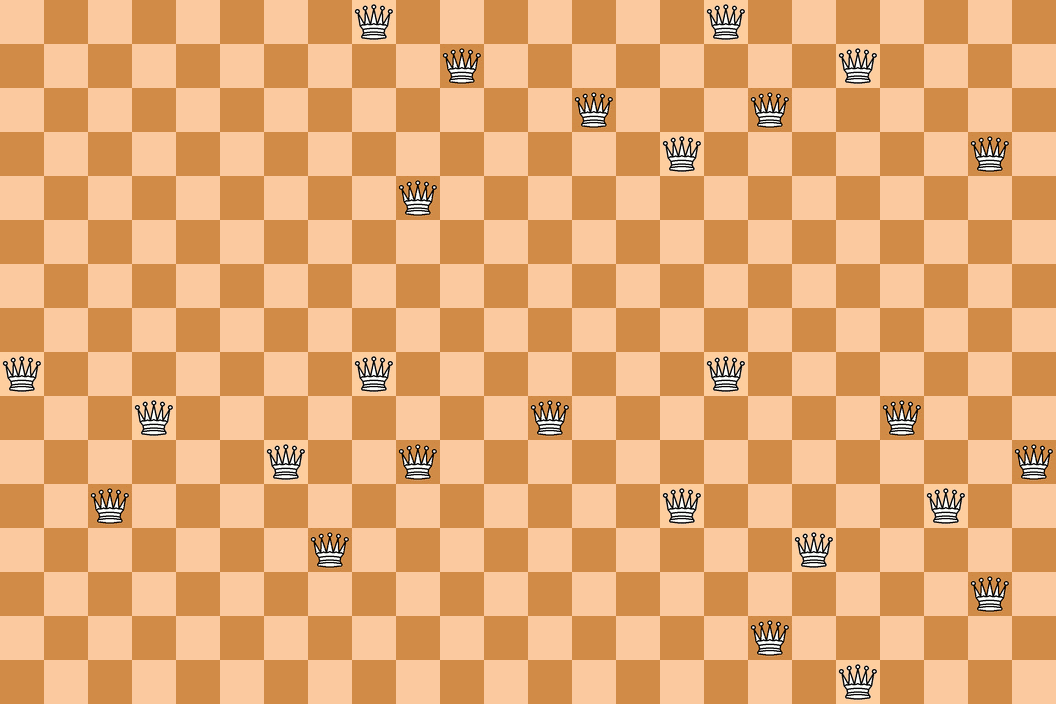
**Given** a chess board of size `n` rows and `n` columns
**Find** a placement of `n` *queens* so none can **kill** each other!
 ## Generate and Search: The N-Queens Puzzle
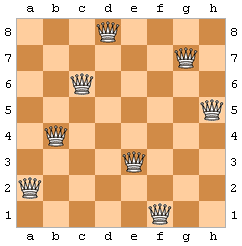
**Given** a chess board of size `n` rows and columns
**Find** a placement of `n` *queens* so none can **kill** each other!
 # First: **What is a Solution**?
## Generate and Search: The N-Queens Puzzle
The first question: **what is a solution** ?
## Generate and Search: The N-Queens Puzzle
The first question: **what is a solution** ?
We represent each queen by its **position** `XY`: a pair of `(row, col)`
~~~~~{.scala}
type XY = (Int, Int)
~~~~~
## Generate and Search: The N-Queens Puzzle
The first question: **what is a solution** ?
We represent each queen by its **position** `XY`: a pair of `(row, col)`
~~~~~{.scala}
type XY = (Int, Int)
~~~~~
One queen `q1` **can kill** another `q2` if
~~~~~{.scala}
def canKill(q1: XY, q2: XY) =
q1._1 == q2._1 || // same row
q1._2 == q2._2 || // same column
(q1._1 - q2._1).abs == (q1._2 - q2._2).abs // same diagonal
~~~~~
## QUIZ: When is a board safe?
`canKill(q1, q2)` is true if a queen at `q1` **can kill** another `q2`
`queens : List[XY]` is a list of **occupied** positions
`q : XY` is a **new** queen position.
Which expression evaluates to `true` exactly when **none of** `queens` **can kill** `q` ?
**A.** `for (qo <- queens) yield !canKill(qo, q)`
**B.** `for (qo <- queens) yield canKill(qo, q)`
**C.** `queens.exists(!canKill(_,q))`
**D.** `queens.forall(!canKill(_,q))`
**E.** `queens.map(!canKill(_,q)).foldLeft(true)(_ && _)`
List(q1,q2,q3).map(!canKill(_, q))
====> List(!canKill(q1, q), !canKill(q2,q), !canKill(q3,q))
====> List(ck1, ck2, ck3).foldLeft(true)(_ && _)
====> ck1 && ck2 && ck3
## When is a board safe?
`canKill(q1, q2)` is true if a queen at `q1` **can kill** another `q2`
`queens : List[XY]` is a list of **occupied** positions
`q : XY` is a **new** queen position.
### Board is Safe
>- When **for each** `qo` in `queens`, `qo` **cannot kill** `q`
>- `queens.forall (qo => !(canKill(qo, q))`
>- **D:** `queens.forall (!(canKill(_, q))`
>- However, **E:** is *also* right. (Why?)
## Generate and Search: The N-Queens Puzzle
The first question: **what is a solution** ?
We represent each queen by its **position** `XY`: a pair of `(row, col)`
~~~~~{.scala}
type XY = (Int, Int)
~~~~~
One queen `q1` **can kill** another `q2` if
~~~~~{.scala}
def canKill(q1: XY, q2: XY) =
eqRow(q1, q2) || eqCol(q1, q2) || eqDia(q1, q2)
~~~~~
A queen at `q` **is safe** w.r.t. other `queens` if:
~~~~~{.scala}
def isSafe(queen: XY, others: List[XY]) =
others forall (!canKill(_, queen))
~~~~~
## Generate and Search: The N-Queens Puzzle
**Given** a chess board of size `n` rows and columns
**Find** a placement of `n` *queens* so none can **kill** each other!
~~~~~{.scala}
def placeQueens(columns: Int, row: Int) : List[XY]
~~~~~
placeQueens(n,n) ===> val others = placeQueens(n, n-1)
for (x <- 0..n, y <- 0..n)
if (isSafe((x,y), others)
yield (x,y) :: others
placeQueens(N, r) =
### Strategy: Recursive Search
To place queens on row `r` ... `0`
> - (recursively) place queens on rows `r-1` ... `0`
> - for each column in row `r`
> - return position which `isSafe` w.r.t. recursive solution
> - Can anybody see a problem?
## Generate and Search: The N-Queens Puzzle
**Given** a chess board of size `n` rows and columns
**Find** a placement of `n` *queens* so none can **kill** each other!
### Problem
> - Can be **many** ways of placing rows `r-1`...`0`
> - ... but only a few may be compatible with row `r` !
### Solution
> - Return **all** ways of placing rows `r-1`...`0`
> - Try **each** placement for row `r` !
## Generate and Search: The N-Queens Puzzle
**Given** a chess board of size `n` rows and columns
**Find** a placement of `n` *queens* so none can **kill** each other!
~~~~~{.scala}
def placeQueens(columns: Int, row: Int) : List[List[XY]]
~~~~~
### Strategy: Recursive Search
To place queens on row `r` ... `0`
> 1. (recursively) place queens on rows `r-1` ... `0`
> 2. for each (recursive) solution
> 3. for each column in row `r`
> 4. `yield` position which `isSafe` w.r.t. recursive solution
## Generate and Search: The N-Queens Puzzle
**Given** a chess board of size `n` rows and columns
**Find** a placement of `n` *queens* so none can **kill** each other!
### Strategy: Recursive Search
~~~~~{.scala}
def placeQueens(columns: Int, row: Int) : List[List[XY]] =
if (row == 0)
List(List())
else
for { queens <- placeQueens(columns, row - 1)
column <- 1 to columns
queen = (row, column)
if isSafe(queen, queens) }
yield (queen :: queens)
~~~~~
>- **Note:** the base case!
## Generate and Search: The N-Queens Puzzle
**Given** a chess board of size `n` rows and columns
**Find** a placement of `n` *queens* so none can **kill** each other!
### Lets run it: 4 Queens
Just printing the **1** solution (of several)
~~~~~{.scala}
scala> Queens(4, 1)
OOXO
XOOO
OOOX
OXOO
~~~~~
## Generate and Search: The N-Queens Puzzle
**Given** a chess board of size `n` rows and columns
**Find** a placement of `n` *queens* so none can **kill** each other!
### Lets run it: 8 Queens
Just printing the **1** solution (there are **many**)
~~~~~{.scala}
scala> Queens(8, 1)
OOOXOOOO
OXOOOOOO
OOOOOOXO
OOXOOOOO
OOOOOXOO
OOOOOOOX
OOOOXOOO
XOOOOOOO
~~~~~
## Generate and Search: The N-Queens Puzzle
**Given** a chess board of size `n` rows and columns
**Find** a placement of `n` *queens* so none can **kill** each other!
### Lets run it: 2 or 3 Queens
~~~~~{.scala}
scala> Queens(2, 1)
scala> Queens(3, 1)
scala>
~~~~~
> - **Say what?!** There are no solutions for $N = 2, 3$
# Iteration + Recursion + Filter = Fun Continues
# Generate and Search: A Sudoku Solver
## Generate and Search: A Sudoku Solver
### **Given** A sudoku puzzle
List[List[Int]]
~~~~~{.scala}
5, 3, , , 7, , , ,
6, , , 1, 0, 5, , ,
, 0, 8, , , , , 6,
8, , , , 6, , , , 3
4, , , 8, , 3, , , 1
7, , , , 2, , , , 6
, 6, , , , , 2, 8,
, , , 4, 1, 0, , , 5
, , , , 8, , , 7, 0
~~~~~
## Generate and Search: A Sudoku Solver
### **Find** A solution
~~~~~{.scala}
List(List(5, 3, 4, 6, 7, 8, 0, 1, 2)
,List(6, 7, 2, 1, 0, 5, 3, 4, 8)
,List(1, 0, 8, 3, 4, 2, 5, 6, 7)
,List(8, 5, 0, 7, 6, 1, 4, 2, 3)
,List(4, 2, 6, 8, 5, 3, 7, 0, 1)
,List(7, 1, 3, 0, 2, 4, 8, 5, 6)
,List(0, 6, 1, 5, 3, 7, 2, 8, 4)
,List(2, 8, 7, 4, 1, 0, 6, 3, 5)
,List(3, 4, 5, 2, 8, 6, 1, 7, 0))
~~~~~
# First: What is a Board & Solution?
## Generate and Search: Sudoku Solver
The first question: **what is a sudoku board** ?
## Generate and Search: Sudoku Solver
The first question: **what is a sudoku board** ?
### Representing Squares
We represent each **square** by its **position** `XY`: a pair of `(row, col)`
~~~~~{.scala}
type XY = (Int, Int)
~~~~~
## Generate and Search: Sudoku Solver
The first question: **what is a sudoku board** ?
### Representing Squares
We represent each **square** by its **position** `XY`: a pair of `(row, col)`
~~~~~{.scala}
type XY = (Int, Int)
~~~~~
### Representing Boards
We represent the **board** by a (partial) map from `XY` to `Int`
~~~~~{.scala}
type Board = Map[XY, Int]
~~~~~
> - How is a **blank** (unfilled) square represented?
> - Simple: the position `XY` is just **not in** the map!
## Representing Sudoku Boards
~~~~~{.scala}
5, 3, , , 7, , , ,
6, , , 1, 0, 5, , ,
, 0, 8, , , , , 6,
8, , , , 6, , , , 3
4, , , 8, , 3, , , 1
7, , , , 2, , , , 6
, 6, , , , , 2, 8,
, , , 4, 1, 0, , , 5
, , , , 8, , , 7, 0
~~~~~
is represented by
~~~~~{.scala}
Map ((0, 0) -> 5, (0, 1) -> 3, (0, 4) -> 7,
(1, 0) -> 6, (1, 3) -> 1, (1, 4) -> 0, (1, 5) -> 5,
(2, 1) -> 0, (2, 2) -> 8, (2, 7) -> 6,
(3, 0) -> 8, (3, 4) -> 6, (3, 8) -> 3,
(4, 0) -> 4, (4, 3) -> 8, (4, 5) -> 3, (4, 8) -> 1,
(5, 0) -> 7, (5, 4) -> 2, (5, 8) -> 6,
(6, 1) -> 6, (6, 6) -> 2, (6, 7) -> 8,
(7, 3) -> 4, (7, 4) -> 1, (7, 5) -> 0, (7, 8) -> 5,
(8, 4) -> 8, (8, 7) -> 7, (8, 8) -> 0)
~~~~~
## Generate and Search: Sudoku Solver
**Given** a partially filled Sudoku `Board`
**Find** a way to fill in **all** squares
### Strategy: Recursive Search
> - **If** no blank squares on board then
> - **return board!**
> - **Else** pick blank with **fewest** possible choices
> - for each choice
> - recursively solve board with blank filled by choice
## Generate and Search: Sudoku Solver
**Given** a partially filled Sudoku `Board`
**Find** a way to fill in **all** squares
### Strategy: Recursive Search
~~~~~{.scala}
def solve(b: Board) : Iterator[Board] = {
val blanks = candidates(b)
if (blanks.isEmpty) Iterator(b)
else {
val (xy, choices) = blanks minBy (_._2.length)
for (choice <- choices.toIterator;
bFull <- solve(b + (xy -> choice)))
yield bFull
}
}
~~~~~
## Generate and Search: Sudoku Solver
~~~~~{.scala}
def solve(b: Board) : Iterator[Board] = {
val blanks = candidates(b)
if (blanks.isEmpty) Iterator(b)
else {
val (xy, choices) = blanks minBy (_._2.length)
for (choice <- choices.toIterator;
bFull <- solve(b + (xy -> choice)))
yield bFull
}
}
~~~~~
### Questions
> - Why do we compute **all** solutions?
> - Why the `.toIterator` call?
## Generate and Search: Sudoku Solver
### Details: Computing `candidates` for a board
~~~~~{.scala}
def candidates (b: Board) =
for { x <- 0 until 9 ;
y <- 0 until 9 ;
if (!b.isDefinedAt((x,y))) ;
xy = (x, y) ;
vals = (0 until 9) diff (alreadyTaken(x,y,b)) }
yield (xy, vals)
~~~~~
> - **Loop** over all squares,
> - **Filter** the ones that are not defined,
> - **Prune** the already taken values for the square,
> - **Yield** a tuple of the cell and remaining values.
## Generate and Search: Sudoku Solver
### Details: Computing `alreadyTaken` values for a square
~~~~~{.scala}
def alreadyTaken(x: Int, y: Int, b: Board) =
for (p <- pointsOfCol(x) ++
pointsOfRow(y) ++
pointsOfGrid(x, y)
if b.isDefinedAt(p))
yield b(p)
~~~~~
> - **Loop** over squares in same **row**, **col**, **grid**
> - **Yield** values at the square (if defined)
## Generate and Search: Sudoku Solver
### Details: Points in Same Grid
~~~~~{.scala}
def pointsOfGrid(x: Int, y: Int) = {
val (x0, y0) = ((x/3) * 3, (y/3) * 3)
for (px <- x0 until x0 + 3 ;
py <- y0 until y0 + 3 )
yield (px, py)
}
~~~~~
### Details: Points in Same Row/Column
~~~~~{.scala}
def pointsOfCol(x: Int) =
for (y <- 0 until 9) yield (x, y)
def pointsOfRow(y: Int) =
for (x <- 0 until 9) yield (x, y)
~~~~~{.scala}
# Lets run the solver!
## Today: Iteration AND Recursion
Elegant way to *systematically*
1. Generate Combinations
2. Search Combinations
3. Generate & Search Combinations
### How ?
>- **Recursively** generate & solve sub-problems, and
>- **Loop** over candidates & yield valid solutions
# PSA: Why choose `Iterator` vs. `List`
## PSA: Why choose `Iterator` vs. `List`
We **chose** `Iterator` and not `List` for password crack
- [Words.scala](http://cseweb.ucsd.edu/classes/fa12/cse130-a/static/pa5/Words.scala)
- [Crack.scala](http://cseweb.ucsd.edu/classes/fa12/cse130-a/static/pa5/Crack.scala)
### Why?
### **Not** to make you write
~~~~~{.scala}
words.toList.filter(...).toIterator // yuck
~~~~~
## PSA: Why choose `Iterator` vs. `List`
We **chose** `Iterator` and not `List` for [password crack](http://cseweb.ucsd.edu/classes/fa12/cse130-a/static/pa5/Crack.scala)
### **Not** to make you write
~~~~~{.scala}
words.toList.filter(...).toIterator // yuck
~~~~~
### which is **the same** as
~~~~~{.scala}
words.filter(...) // sweet!
~~~~~
> - The yucky version is not just longer ...
> - ... it can be massively **inefficient**!
## PSA: Why choose `Iterator` vs. `List`
We **chose** `Iterator` and not `List` for [password crack](http://cseweb.ucsd.edu/classes/fa12/cse130-a/static/pa5/Crack.scala)
### Because `Iterator` lazily computes one element at a time
At each `.next` call
> - **Does not** build the **entire sequence** up at once! (as `List` does)
> - **Does not** store the **entire sequence** in memory! (as `List` does)
## PSA: Why choose `Iterator` vs. `List`
We **chose** `Iterator` and not `List` for [password crack](http://cseweb.ucsd.edu/classes/fa12/cse130-a/static/pa5/Crack.scala)
### Because `Iterator` lazily computes one element at a time
At each `.next` call
- **Does not** build the **entire sequence** up at once! (as `List` does)
- **Does not** store the **entire sequence** in memory! (as `List` does)
### So `Iterator` good for operating on big data **streams**
> - Like large dictionaries of words ...
> - ... and transformations thereof
## PSA: Why choose `Iterator` vs. `List`
### `Iterator` is lazy, good for operating on big data **streams**
~~~~~{.scala}
def allVowels(megaDictionary: Iterator[String]): Iterator[String] =
for { w <- megaDictionary
; if hasAllVowels(w) }
yield w
~~~~~
> - `Iterator` uses O(1) memory (at any given time) ...
~~~~~{.scala}
def allVowels(megaDictionary: List[String]): List[String] =
for (w <- megaDictionary
if hasAllVowels(w))
yield w
~~~~~
> - `List` uses O(N) memory, where N = `megaDictionary` size.
## PSA: Why choose `Iterator` vs. `List`
We **chose** `Iterator` and not `List` for [password crack](http://cseweb.ucsd.edu/classes/fa12/cse130-a/static/pa5/Crack.scala)
### `Iterator` is lazy, good for operating on big data **streams**
~~~~~{.scala}
def txReverse(megaDictionary: Iterator[String]): Iterator[String] =
for (w <- megaDictionary
c <- Iterator(w, reverse(w))
yield c
~~~~~
- `Iterator` uses O(1) memory (at any given time) ...
~~~~~{.scala}
def txReverse(megaDictionary: List[String]): List[String] =
for (w <- megaDictionary
c <- Iterator(w, reverse(w))
yield c
~~~~~
- `List` uses O(N) memory, where N = `megaDictionary` size.
### Note: Only difference is in the **type**
## PSA: Why choose `Iterator` vs. `List`
We **chose** `Iterator` and not `List` for [password crack](http://cseweb.ucsd.edu/classes/fa12/cse130-a/static/pa5/Crack.scala)
### `Iterator` is lazy, good for operating on big data **streams**
### So why not always use `Iterator` ?
> - Cannot **reuse** after reaching the **end**
> - Cannot **rewind** `Iterator`
> - Cannot **randomly** access (efficiently)
## PSA: Bottom-line
For PA5
> - Stick to using `for` and `yield` and HOFS
> - Do **not** convert from `Iterator` to `List`
> - Or you will have all sorts of (unsolvable) memory issues