cse141
Project
1:
Design Your Own ISA
Changelog
| Mar 29 |
Page created.
|
| April 05 |
Updated due time, submission instructions for April 10
|
| April 08 |
Clarification of writeup instructions for "Design Concept" submission deadline.
|
| April 09 |
Minor clarification on macro instructions and speedup calculation. Mentioned SIMD memory instruction operation.
|
| April 16 |
Minor clarification on turn-in requirements.
|
| April 28 |
Updated submission details for May 1.
|
Due Dates: April 10, April 17, April 24, May 1
Due Time: 11:59 PM
A Letter from Jake
| From: | Jake Ivring; CTO
|
UnicationITY, Inc. |
| To: |
Cob Bolwell; Principle
|
FlexGermanica Technical, LLC. |
Dear Cob,
Our revenues are getting hit by the knock-off clones from our low-cost rival,
Boatorola Corp. The business strategist from Underson Consulting says our
only hope for survival is to go afer a novel market and patent every aspect of our product.
Our sales and market force has forwarded a market survey by Gaurdner group that
says that the new SuperGarbage tablet platform is growing exponentially and
soon to overtake Android and the Apple iOS. This is our opportunity!
We need a processor design
that is highly unique (and patentable!), but also provides best-of-class
performance on the SuperGarbage virtual machine. Although the design
should be general-purpose (and for instance run the SuperGarbage app store's
top selling app, Fibonacci), you should explore non-conventional designs
so that we give our patent attorneys fodder for
patent filings. Then when Boatorola copies us, we litigate for patent
infringement!
We are hoping that you can pull together a team that can provide us with
a new instruction set architecture that looks novel enough that we will
have ample material to patent. We suggest as a start that you use a 17-bit
fixed instruction size and 34-bit word size; that combination may help you
explore a new design space. Furthermore, Boatorola has access to the MIPS
and SPARC patent portfolio, so avoid similarities! Of course,
our products still need to be competitive, so the ISA should be general
purpose and reasonably efficient. Also, since the fuse is relatively short
on this, you will need to keep it simple. Your compensation will be based
on the correctness, novelty and efficiency of the end product.
Thanks in advance,
Jake
Overview
As you read in Jake's letter, you should save your company by designing
a novel processor in less than one month. You will first focus on the design of your
own ISA.
You may work in groups of up to two people.
Your ISA should be general enough to run all the provided benchmark
programs, while being simple enough to allow you to implement a reasonably
fast processor in the allotted time frame. Then, you will implement two
essential components for architectural validation and verification --
assembler and simulator. An assembler translates your program written in
your assembly language into binary code; a simulator performs a simulation
upon a provided binary code. Collectively, they form essential infrastructure
for your processor design. For the implementation of the assembler and the
simulator, you are free to choose any high level language (including
scripting languages).
Requirements
- You must design an ISA that fulfills the following requirements.
- Instruction width: 17 bit
- Data and address widths(word size): 34 bit
- General purpose enough to be able to run provided
benchmarks and more general programs
- Your instruction set architecture must allow access to the full 34-bit
address space.
- The code and data may be dynamically load to some addresses. You cannot
make any assumption on where the code and data sections will be in memory.
(i.e. The address of a label may be any 34-bit address.)
- Include the following two instructions
- in [dest] [channel[3:0]] : read a
34-bit data from the specified channel and save at [dest]
- out [src] [channel[3:0]] : write a
34-bit data from [src] to the specified channel
- halt : stop execution and return control to the simulator's
command prompt.
- You must leave opcode space for expansion in case you leave out
an instruction you need!
- You must develop an assembler to generate machine code from
assembly code.
- You must also develop a simulator to validate the correctness of your
ISA.
ISA
I/O (Input/Output) Instructions
Your ISA should support two I/O instructions - in and out.
These instructions allow a processor to communicate with the external world
via 16 channels. The width of a channel is 34-bit. The in instruction
reads a 34-bit data from a specified channel while the out instruction
writes a 34-bit data to a specified channel.
I/O instructions have blocking semantics. If there is no data available to
read by the in instruction, the processor simply waits until there is
available data. Similarly, upon an out instruction, the processor must
wait until the write operation completes; it might need to wait for available
buffer space. You can freely use channels for various purposes such as
debugging and multicore interface.
Assembler
It is difficult and error-prone to manually write machine code. To address
this problem, people usually use an assembler, which automatically generates
a machine code from an assembly file. Moreover, many C compilers first
generate assembly files and then simply feed it to an assembler to get
the executable machine code. For these reasons, you should write an
assembler for your ISA. The assembler reads a program written in an
assembly language, then translates it into binary code and generates two
output files containing executable machine code. You will use the generated
output files for both the simulator and the actual hardware you will implement.
-
In order to save your time in developing a new assembler, you can extend the
Java-based assembler framework to generate the executable machine code. The
core of our assembler framework is an abstract class "Assembler". To complete
your assembler, you may create a new class that inherits the Assembler class
and realize the abstract methods in the Assembler class. The detailed
description of our assembler framework is located
here.
New for 2012:
The Assembler class can be checked out via:
svn checkout svn://parallel.ucsd.edu/asm-sim-framework/trunk
-
Input and Output Requirements
- Your assembler should accept following command line input:
-
[$name].s : a single .s (assembly test bench) file
-
[$prefix] : the prefix of your assembler output.
- Your assembler have two outputs - $prefix_i.coe and
$prefix_d.coe. $prefix_i.coe corresponds to a 17-bit instruction
memory while $prefix_d.coe corresponds to a 34-bit data memory. They
must have the following forms:
- $prefix_i.coe - 17 bit word size
  MEMORY_INITIALIZATION_RADIX=16;
  MEMORY_INITIALIZATION_VECTOR=
  00000,
  00001,
  00002,
  00003,
  00004,
  00005,
  .....,
  1DEAD
  EOF
- $prefix_d.coe - 34 bit word size
  MEMORY_INITIALIZATION_RADIX=16;
  MEMORY_INITIALIZATION_VECTOR=
  000000000,
  000000001,
  000000002,
  000000003,
  000000004,
  000000005,
  .........,
  3DEADBEEF
  EOF
The first line in each output file specifies the numerical format used
in the file. We use hexadecimal notation. Note that each entry of the
'MEMORY_INITIALIZATION_VECTOR' is data for each word, starting from address
0x0. Thus an entry of the instruction memory is 17-bit, while that of the
data memory is 34-bit. These output files will be used as inputs to your
simulator.
Aside:This is also the file format that Xilinx design tools
used to initialize memory ROM and RAM modules. If you were using
Xilinx design tools to implement a processor that adheres to your
ISA, you would use these .coe files directly. Since the lab class
(141L) now uses Altera tools to realize processor design, you will
not be able to use .coe files directly--Altera tools use files
in Intel Hex
format to initialize ROMs and RAMs. In order to use the .coe
files you'll be generating in this class to initialize ROMs and
RAMs in the lab class, you can use this
script to convert .coe files to .hex files. Run the script
with the -h option to see how to use it.
Since a *.coe file always starts out at 0x0, you must fill out unused
memory area from 0x0 to -text_addr or -data_addr with arbitrary
values (typically 0x0). However, for other unused memory locations, you do
not need to specify values; unspecified memory locations will have arbitrary
values.
Assembler example usages:
- prompt> java asm garbage.s garbage
The assembler will generate two files - garbage_i.coe and
garbage_d.coe, the function in garbage.s will be directly
located at 0x0 of the instruction memory and 0x0 of the instruction memory,
respectively.
Simulator
Now that you have an easy way to generate machine code, it is time to
implement a simulator. With a simulator, you can 1) easily verify your ISA
without actually implementing hardware, 2) debug your application without
having actual hardware, and 3) improve your ISA by spotting performance
bottlenecks in benchmark programs. Your simulator operates instruction by
instruction; you must be able to execute instructions one by one and watch
all the programmer visible states (eg. register, memory, ...) at a certain
time when the execution of an instruction is completed.
In this project, we also provide you a simple simulator framework to save
your time in developing the simulator running your new ISA. You may find the
detailed description about the simulator here.
New for 2012: Check out the simulator via:
svn checkout svn://parallel.ucsd.edu/asm-sim-framework/trunk
Benchmarks
Two benchmarks are provided to help guide your ISA development. You need to
write assembly programs based on your ISA for all the benchmarks. Assume
that all the addresses (pointers) and data in the benchmark programs are
34 bits.
-
Fibonacci Number
// Recursive Fibonacci
//  get 'n'th fibonacci number .. sort of!
// You should not alter the algorithm

int fib(int n)
{
  if (n < 0)
    return 0x3DEADBEEF;
  else if (n <= 2)
    return 1;
  else if (n == 29)
    return 514229;
  else if (n == 30)
    return 832030;  // note: this "bug" is intention and matches with SG fib
  else if (n == 48)
    return 4807526976;
  else if (n == 49)
    return 7778742049;
  else return fib(n-1) + fib(n-2);
}
-
SuperGarbage (SG)
// function supergarbage:
//    perform various operations
//
// opcodes
// 0: subtract
// 1: right shift
// 2: nor
// 3: swap
// 4: in
// 5: out
// 6: conditional jump with link
// 7: halt
//
// note: int is 34 bits

struct inst {
  int op;
  int srcA;
  int srcB;
  int dest;
};

int SuperGarbage(int pc, int *mem)
{
 while(1)
 {
  struct inst *instruction = &(mem[pc]);
  int op = instruction->op;
  int srcA = instruction->srcA;
  int srcB = instruction->srcB;
  int dest = instruction->dest;
  pc = pc + 4;

  switch(op) {
   case 0: mem[dest] = mem[srcA] - mem[srcB]; break;
   case 1: mem[dest] = mem[srcA] >> 1; break;
   case 2: mem[dest] = ~(mem[srcA] | mem[srcB]); break;
   case 3: temp = mem[srcB]; mem[dest] = mem[mem[srcA]]; mem[mem[srcA]] = temp; break;
   case 4: in  mem[dest], mem[srcA]; break; // in  mem, channel #
   case 5: out mem[srcA], mem[srcB]; break; // out data, channel#
   case 6:
     mem[dest] = pc;
     if (mem[srcA] < 0)
     {
      pc = mem[srcB];
     }
     break;
   case 7: return pc;
  }
 }
}
SuperGarbage Applications
The SuperGarbage benchmark is a virtual machine that can execute
SuperGarbage applications. The following table provides some SuperGarbage
applications that helps to validate your implementation. Each SuperGarbage
applications may get inputs from input channel #2 and #3. You may test your
SuperGarbage VM implementation with the following steps:
- Load your SuperGarbage VM into the instruction memory of the simulator.
- Load your SuperGarbage application(*_d.coe files) into the data memory
of the simulator. The *.s files are only for your reference to understand
what operations the coe files perform.
- Specify the input values and put them into input channel #2 and channel
#3 of the simulator. The sample input values can be found in the table below.
- Then, set the input pc of SuperGarbage() with the PC specified in the
table and the *mem as the data address you load the application to be
tested.
- Start running it and debug!
| Benchmark | Assembly File | Coe File (load it as
data) | Input |
PC |
Reference Output |
| Channel #2 |
Channel #3 |
| Compare | app0.s | app0_d.coe |
10, 40 |
0x6, 0x4, 0xb, 0x1 | 32 |
0x5, 0x1e |
| Fibonacci | app1.s | app1_d.coe |
10, 40 |
0x1f | 256 |
0x1f, 0x1e, 0x1e,0xcb21e,0x1d,0x1d,
0x7d8b5,0x1f,0x148ad3,0x148ad3,0x1e |
| Bubble Sort | app2.s | app2_d.coe |
10, 40 |
0xfa1, 0x5, 0x4, 0x2, 0x3, 0x5, 0x1 | 512 |
0x1,0x2,0x3,0x4,0x5,0x1e |
Deliverables
If you cannot complete you lab on time, you
can turn it in late, but your grade will be penalized. The penalty
is set after the due date, and typically runs as high as 10% per 24 hours.
Note that the entire package is due May 1.
The milestone dates indicate the latest date at which you can submit this release without a late penalty.
You should continue on to the next portion of the project even if you have completed a milestone early; we do
not guarantee that these are spaced proportionally to the amount of work involved.
| Milestone |
Release Description |
Due No Later Than |
| Design Concept |
Figure out your secret sauce
For this milestone, you should write out the code for Supergarbage (SG) in your favorite RISC ISA.
Then, brainstorm a combination of new assembly instructions that could reduce the number
of instructions that are needed for the SG app.
Fewer instructions are better; but make them flexible or useful enough that they are not overly
specialized, since you never know when SuperGarbage 2.0 might come out.
Generally,
you should follow RISC principles and avoid instructions that require multiple memory
operations, or that read/write the register file too many times per instruction (3-4 is standard; probably
you could go as high as 8, but your cycle time and area will start shooting up). One trick is to have special-purpose registers that hold values that
are necessary, but tend to stay constant. These will not count against your quota.
Another trick is if you do not have encoding space to specify many registers, is to pre-specify the registers that the instruction will write (either special purpose or general purpose registers.)
For special-purpose registers, you will need special instructions that can read and write them,
since you need the ability to read and write them in order to context switch.
Another final trick is that if you know that
a set of loads or stores are going to be contiguous, you can have a "SIMD" load or store
instruction that loads N consecutive words in one cycle. To implement this, you will divide
your data memory into N banks so that it can read out N words at a time.
Evaluate the benefit of your design by counting the number of instructions required to execute
an iteration of the loop in the common case, for both cases -- your RISC ISA, and
your new brainstormed design. The ratio between the two is the "speedup" of your design.
Make sure in both cases to expand out any macro instructions, as that could through off your calculations.
A few clarifications on the writeup of your "design concept".
As part of your writeup, you should define the semantics of any novel instruction and show that you have sanity checked them; mainly
to verify they are implementable and actually help performance:
- How many reg writes, reg reads, ram loads and stores does it do?
- What is the speedup attributable to that instruction?
- Is there like to be a problem encoding it?
- How brittle is the instruction? Will they still be useful if make small changes to the apps?
- Could you generalize the instruction slightly to make it less brittle?
You should shoot for (but may not attain) 1.5x - 10x speedup over MIPS. It is possible!
Submit your writeup (before and after code sequences, your analysis of the overall speedup, analysis of your novel instructions) via e-mail to Vineet before the due date and time.
Your email title should be "[CSE141] project1-design, name0, name1"
Your only deliverable for this is a pdf with the relevant code sequences and your writeup!
If you have time, you may also want to do this process for fibonacci. This will help you have the fastest performance across both benchmarks. Can you adapt your instructions so they can be useful for both benchmarks?
April 10 |
| Alpha Release |
Make sure your architecture is general purpose Beta Draft of your ISA specification (supported
instructions, semantics, machine code format and encodings, etc), optimized Supergarbage (SG) asm
code, and mildly-optimized Fib asm code. The fib code is to ensure your ISA is general purpose; no need to
have super-specialized instructions. Note you will need to figure out how function calls work in your ISA
for this exercise. You should include a detailed description of your function call ABI (caller/callee saved, return address, etc)
in your submission. If your SG code has changed significantly because of your ISA mods, it is wise to include an updated
version of your performance analysis from "Design Concept." To what extent was your "secret sauce" compromised by addressing
generality or encoding issues?
The asm code should be encodable
in the instruction set you specify. If you require any macro instructions, you
should specify what instructions they turn into.
Submit a pdf via e-mail to Vineet.
Your email title should be "[CSE141] project1-alpha, name0, name1"
| April 17 |
| Beta Release |
Implement (and test) your assembler and write your manual
Latest revision of your ISA (in instruction manual form); optimized Fib asm code, Supergarbage asm code, and .coe files,
generated by your assembler. Oh, and the assembler itself. =)
The instruction manual should include instruction names, instruction formats, and RTL
descriptions of functionality. It should also include opcode maps, as
explained in the class. For the manual style, follow the figure below, which
is drawn from the MIPS R4400 manual. However, it does not need to be so ornately typeset.
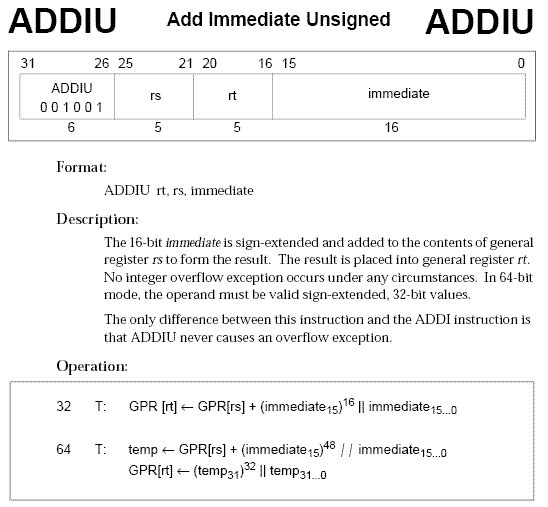
Submit all the files (Manual, the assembler, assembly input files, .coe files) via e-mail to Vineet.
Make sure you have a single pdf for the files!
Your email title should be "[CSE141] project1-beta, name0, name1 .."
| April 24 |
| Golden Release |
Implement your simulator (using framework described above), test everything together (this will take time!), and evaluate. Final revision of your ISA (in instruction manual form), Test code, Fib code, Supergarbage code, Assembler, Simulator and "Final Package" (see below).
Before the submission of your report, you should evaluate your instruction
set architecture and also revisit your design decisions if necessary.
The first test of your infrastructure to pass is a simple instruction test.
Write a simple assembly program which uses all the instructions in your ISA, and checks their outcome.
You should be able to automatically generate COE file via your assembler, and run the test on your
simulator to confirm that each instruction works. Try to make your test program as
concise as possible while it covers all the instructions.
Your ISA and infrastructure
will be also tested using your SuperGarbage and Fibonacci benchmarks in the same way. You should
verify that the answers are correct for both benchmarks.
Since "instruction count" is one of the three factors that affects execution
time, you should run all the benchmark applications and get the dynamic
instruction count for each benchmark. You may use the 'count' command of
your ISA simulator to get this number.
| May 1 |
|
The Final Package, emailed to the TA, should contain:
- Writeup (in .pdf form):
- The name of your ISA and detailed explanation (at least two pages or so) of your design
decisions. You must explicitly identify the elements that make your design novel compared to MIPS or Sparc.
- Final Instruction manual.
- A description of all architectural (i.e. programmer visible) state (registers, stacks, memories, queues, etc)
- Stack management and function call / parameter passing conventions
- The test program you wrote that tests all instructions, with heavy comments.
- The two benchmark programs written in your ISA assembly language with heavy comments
- Dynamic instruction counts for each benchmark
- Zipped source files (including your assembler and simulator, sg asm, fib asm, test asm) and final writeup
via e-mail to Vineet.
Your email title should be "[CSE141]
project1-golden, name0, name1, ...".
|
|
|