CSE 160, Spring 2004
Homework #4
Due
Late assignments will not be accepted
[10 points]
- K-ary d-cubes.
The k-ary d-cube is an interconnection network with kd nodes. As discussed in class, there are k nodes along all d axes and there are end-around connections.
- Derive the diameter and the bisection bandwidth of a k-ary d-cube.
- A
ring is a special case of 1-cube. Give a formula that maps
a ring with kd nodes onto
a k-ary d-cube with kd
nodes. There are many possible
mappings, but choose just one.
- Parallel prefix.
The prefix sum (also called a sum-scan) of a sequence of
numbers xk is in turn a sequence of
running sums Sk defined as follows
–
S0 = 0
–
Sk
= Sk-1 + xk
Thus, scan (3,1,4,0,2)
= (3,4,8,8,10)
a. Design an algorithm for prefix sum based on the ring interconnect.
b. Derive an accompanying performance model
3. Time constrained scaling.
a. Devise
an efficient parallel algorithm for adding up a list of N numbers on P
processors. Assume that there P divides N evenly and that N >> P
(i.e. N > 10*P or more)
b. Now, determine the largest problem that can be solved in time T = 10000 time units on 500 processors, where the message startup costs alpha= 200 time units, and addition costs 1 time unit.
4. Performance
modeling.
In class we derived a performance model for a 5-point 2D Jacobi
solver which is used to solve Poisson’s equation.
a. In
some applications, a more accurate way to solve the equation is to use the
so-called 9-point stencil. One such stencil is shown in Fig 10.24 of the text . (See “Higher
order Difference Methods,: pp 323-324).
Derive a performance model for this stencil, expressing the parallel
running time TP as a function of P and N. Assume that the problem size square, that is,
the solution mesh is
N ´
N. Break out the computation and
communication costs and compare against that of the 5-point stencil. Which stencil incurs a higher communication
cost?
b. There
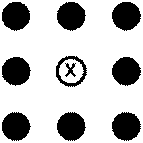
is a different 9-point stencil that uses all 8 nearest neighbors as shown below. A straightforward approach to updating ghost
cells requires communication from the 8 nearest neighbor processors. However,
there is a different
communication algorithm that involves only 4 neighbors along the