CSE 121 Spring 2003 Homework 2
Due Midnight, 2 May 2003
Please turn in a tar file that contains
your program and your solutions for Problems 1 and 2. For the
problems that don't require a program, you can just submit a simple ASCII
file.
Problem 1
Please read the section on checkpointing
and recovery in Rosenblum's LFS paper that was passed out
in class.
In Sprite LFS, segments are written from back to front. For example,
below is a diagram showing a segment that has had one write
performed on it.

After one more write, the segment could look like this:
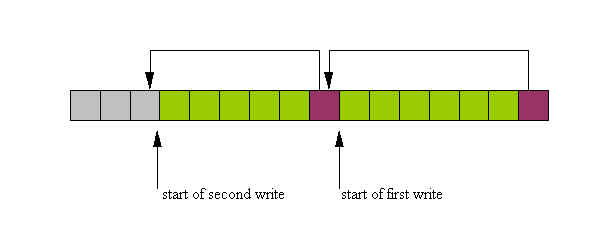 A third write would fill the segment (in this
diagram, it would write two data/inode blocks and one summary
block) and then start filling a new segment.
- Consider the roll-forward procedure
in crash recovery for Sprite LFS. How does the roll-forward
procedure determine when to stop rolling forward? If you can't
determine this from the paper, then make an educated guess and justify
your guess.
- Sprite LFS wrote the segments as outlined
above because it allowed the cleaner and the roll-forward procedure
to make the assumption that if a segment summary block was safely
written to disk (such as the last block in the segment shown above),
then all of the blocks described by the segment were also safely
written to disk. Unfortunately, this is based on the assumption that
a disk controller writes blocks in the sequence they are stored in
memory. In order to reduce rotational latency, some controllers start
the write transfer depending on the current rotational position of the
head. For example, in the first write shown above, the controller could
first write out the last three green blocks, and then the segment summary
block, and then finally the first three green blocks.
What impact does this have on recovery? How would you change the way
that LFS writes data to disk (the order, the contents, or
both) in order to accommodate such disk controllers.
Problem 2
Consider the following code that inserts a node into a doubly
linked list (using fields prev and next) sorted on
the field key. It is a non-unreasonable approximation to
what Rio might use to maintain the list of buffers that the recovery
code will reference upon rebooting.
void InsertNode (Node* first, last, new) {
Node *at = first;
while (at != NULL && at->key >
new->key) at = at->next;
if (at == NULL) { //
Insert as last node in list
new->prev = last;
new->next = NULL;
if (last == NULL) first = new;
else last->next = new;
last = new;
}
else {
// Insert before
at
new->prev = at->prev;
new->next = at;
if (at->prev == NULL) first
= new;
else at->prev->next = new;
at->prev = new;
}
}
- Consider using the Rio cache approach: this routine is
used to maintain a data structure that is read after the machine
recovers from a crash.
How could a machine failure leave
this doubly linked-list in an unsafe condition?
- Suppose that Rio indeed used such a doubly-linked
list. How would you design Rio to deal with the problem?
(Note that you have two general choices to consider: either
doing something so that the datastructure is not seen in an unsafe
condition or doing something to make it consistent).
- The Rio paper does not discuss the impact of either the L1
or L2 cache. The existence of such caches complicate building Rio.
Explain why, and how one could change Rio to accomodate such hardware
caches.
Problem 3
Design and write a C program that will
allow you to determine the size of the file cache in an operating
system, assuming (reasonably) that the cache is finite and that
it uses an LRU replacement policy. Use your program to see how large
the file cache is for some machine. Your answer should include a description
of the ideas behind your program, and your analysis that led to your
measurement of the file cache size.
Note that if decide to measure the file cache
size of ieng9 you are most likely going to thrash the file cach,
and you'll be competing with other users for the use of file
cache. You need to run your program either on your own personal
computer or on one of the individual workstations in EBU2 313, EBU1
3327, EBU3329, or APM B402 so that you are the only user of the computer.
The room EBU2 313 usually has quote low traffic, and so you might try
those first.
If you use one of the individual workstations,
then you may fiind the file bigfile in public/hw2/
useful. This is a 1G file that contains a random number as
an ASCII characters string (nonzero terminated).
If you wish your program to measures times, then you might want to use the
routine gethrtime. Use man gethrtime for
details.
Hint: If you use one of the ieng9 workstations, then there
will be two caches: one associated with your workstation and
one associated with the NFS server. Be careful to report the size of
the first cache (although, if you wish, you could measure the size of
each. If you do this, then try to choose a time when that server
should be lightly loaded, since otherwise you'll be competiting with
other users for the NFS server's cache).
last edited by Keith Marzullo on 22 April 2003