Lecture #9: More Operators and Expressions
Bob Pitha
bpitha@cs.ucsd.edu
http://www-cse.ucsd.edu/classes/fa99/cse5a
quiz issues
• On Friday in class
– it will not be a Big Exam
• What will it cover?
– everything we’ve talked about!
• Please be on time
• Bring a #2 pencil
question
• How many of you would use a copy of Visual C++?
– you’d have to have a PC running Windows
arithmetic operator example
• Leap year determination
– A year is a leap year if it is divisible by 4 but not by 100, except for years divisible by 400.
– Let’s ignore all but the “divisible by 4” rule…

increment/decrement operators

• Unusual operators: they change their operand (“side effect”) as well as return a value
• Single operand
• 2 flavors: pre- and post-
– preincrement/predecrement
• value of expression is modified value
– postincrement/postdecrement
• value of expression is value before modification
• Can be used as a statement by itself, to just modify the value
single operand
• This is our first example of a unary operator
– that’s just a fancy name for an operator that takes only one operand
preincrement/predecrement
•
Operator comes before value: ++i
• Value of expression is incremented/decremented value
• Example:
int i = 12;
int j;
j = ++i;
Final value of i is 13, j is 13
computer simulation: preincrement
postincrement/postdecrement
• Operator comes after value: i++
• Value of expression is the original value, before it was modified.
• Example:
int
i = 12;
int
j;
j
= i++;
Final value of i is 13, j is 12
computer simulation: postincrement
increment/decrement operators (cont.)
• Overflow for signed integer types is undefined
– “overflow” means going beyond the range the type can hold
– “undefined” means the ANSI standard doesn’t constrain what must happen
– So it depends on the machine/compiler you are using
• Overflow for unsigned integer types “wraps around”:
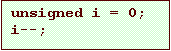
i is now 4 billion and something.
precedence and associativity

precedence and associativity
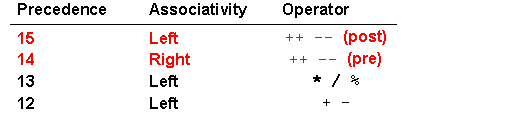
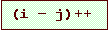
• This means the following expression:

• is interpreted as:

• and not as:
increment example
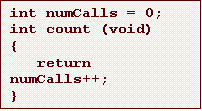
• This is a function that returns a number
– every time it’s called, the number is one greater than the last time
simple assignment operator
=
• Sets the value of the lefthand operand to that of the right (after conversions)
• Left operand must be an lvalue
• Value of expression is the new value of the lefthand operand
– i.e., the converted value
value of assignment expression
• What does this mean?
– remember that expressions can have both a value and an effect
– with the = operator, the effect is the primary reason for its existence
• it sets the value of an object
– however, the whole expression has a value
• which is the new value of the lefthand operand
– this means the following statement is legal:

compound assignment operators
+= -=
*= /= %=
• Binary operators
• a op= b is equivalent to a = a op b
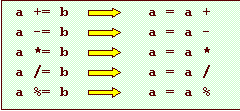
• Operand types are restricted as for the normal arithmetic operators
precedence and associativity

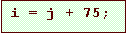
• The assignment operators are almost the lowest precedence
– we want to evaluate everything to the right of the = before assigning the value to the lefthand operand
assignment Issues
• Right associativity means that
a = b = c = d + 7
and
x
*= y = z
relational operators
> >=
< <=
• All binary operators
– take two operands
• All yield an int, with a value of 1 or 0 (true/false)
– in C, there is no true/false value.
– it’s always 0 or not-0
relational operators
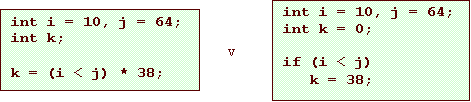
• These are used to compare values, usually when making decisions
– since they yield a value, you could use them in an equation
– but that would be weird
precedence and associativity

• So something like this:

will be interpreted as:

and not

relational operator issues
• Be careful with mixed types
• Example:
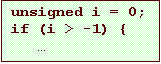
– remember the two operands must be of the same type.
– C converts the –1 to an unsigned value
• which is therefore a very big number
• and (counterintuitively) the expression is actually false