Lecture #8: Operators and Expressions
Monday, October 18, 1999
Bob Pitha
bpitha@cs.ucsd.edu
http://www-cse.ucsd.edu/classes/fa99/cse5a
what’s an operator?
• Something that acts on a variable or an expression
• Does something
– computes or retrieves a value
– changes an object
types of operators
• Arithmetic operators
• Increment/decrement operators
• Assignment operators
• Relational operators
• Equality operators
• Logical operators
• There are others...
expressions
• A complex topic, really
• For our purposes today:
– an operator and its operands
– a variable
• Expressions can be nested

expression concepts
• lvalues
• Conversions
• Operator precedence
lvalue
• This is a tough concept - but necessary!
• Some expressions refer to real memory (objects)
– can have a value assigned
– these are sometimes called lvalues
• because they can be on the left side of an equals sign
• Some expressions are just values
– calculated, used, then thrown away
examples
• Given the declaration
int i;
– i is an lvalue
• so it is legal to say:
i = 1;
– i + 1 is not an lvalue
• because
you can’t assign a value to i
+ 1
• i + 1 is just a computed value; it has no permanent memory associated with it
– 1 is not an lvalue
• you can’t assign a value to a constant
why do we care?
• Some operators require lvalue operands
– Like =
• legal: i = 1
• illegal: i + 1 = 2
• This concept will come up again and again
conversions
• What happens here?
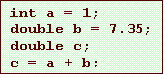
– remember I said the computer does integer and floating-point math differently
– so how does it mix the two?
conversions
• The answer is it finds an acceptable type, and converts whatever is necessary.
– in this example
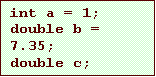
a is converted into a double and a+b is evaluated using floating-point addition
some caveats
• Conversions follow certain rules
– depends on the operator involved
• The old variable isn’t changed
– a new object is created temporarily; you never really see it
– thus, the converted value is not an lvalue
• this isn’t an issue in the simple cases we’ve seen so far
• but it can be in some things we have yet to see
usual arithmetic conversions
• Standard conversions applied to operands to enforce type agreement.
• Most binary operators require operands of the same type
• Usually widen, not narrow, an operand
conversion rules
• Informally:
– If either operand is a long double, convert the other to long double
– Otherwise, if either operand is a double, convert the other to double
– Otherwise, if either operand is float, convert the other to float
– Otherwise, convert char and short to int
– Then, if either operand is long, convert the other to long
conversion example

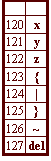
ASCII character set






operator precedence and associativity
• Each expression operator in C has a precedence and associativity rule
• In a compound expression in the absence of parentheses, sometimes interpretation is ambiguous:
a + b * c
• Rules of precedence and associativity clarify such situations
precedence
• Each operator has a precedence level
• Specifies how operands are grouped with operators in ambiguous situations
• Example:
a + b * c
* has higher precedence than +, so this expression is evaluated as
a + (b * c)
associativity
• Some operators have the same precedence
• In that case, associativity rules come into play
• Associativity specifies in what order operators with equal precedence are evaluated
associativity example
a / b * c
• * and / have the same precedence
• * and / are left-associative
– which means left-to-right evaluation:
(a / b) * c
– common sense in this simple example, but less obvious sometimes
arithmetic operators
+
- * / %
• Most of these are straightforward and intuitive
• These all compute values, have no side-effects
• /
Works differently for integers, real numbers: for integers, result is truncated
• the expression 9/10 will have the value 0
%: the modulus operator
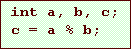
• Computes the remainder of the division
• Both operands must be integers
precedence and associativity
