Lecture #27: More Strings
December 8, 1999
Bob Pitha
bpitha@cs.ucsd.edu
http://www-cse.ucsd.edu/classes/fa99/cse5a
so what else can we do with strings?
• Whatever we want
– we just need functions to do it
• As far as C is concerned, strings are just arrays of chars
– they follow all the same rules as other arrays
– the only possibly exception is initialization
• C gives us a convenient way to initialize a string
![Text Box: int iarray[] = {1,2,3,4,5};
char string[] = “abcde”;](./Lecture27_files/image001.gif)
but we need to do more
• Say I asked you to write a program that let the user enter a date like this:
December 8, 1999
and it should tell me what day of the week it is
– compared to what we’ve done so far, this is a pretty complex problem
– we don’t have to figure this out right now, but let’s look at it a little
our date program
• Given a date like December 8, 1999
– first we have to divide it into pieces
• month (December)
• date (8)
• year (1999)
– that, in itself, is a challenge
• the month name is everything up to the first space
• the date is whatever comes next, up to the comma
– but if it’s not numerals, we have an error
• the year comes last
so what do we do?
• Given a string containing the date, we must:
– extract the month name, probably into another string
– convert the numerals of the date and year from text into numbers
• Then once we have the month name, we have to figure out:
– whether it’s valid
– and if so, what month it is
parsing the string
• Breaking the string down into its parts is sometimes called parsing
– it’s sometimes a very complex task
– this is pretty straightforward as text parsing goes, but it’s still pretty complex compared to what we’ve been doing
– part of that complexity comes from the fact that we can’t assume someone’s entered the date correctly
• we have to deal with things like:
– Dec ember 8, 1999
– December 8 1999
– December8, 1999
• at least to recognize that they’re incorrect
string operations
• So what sorts of things would we have to do?
– scan a string for patterns
• to find the month name, date, and year
– copy out parts of the string into separate strings
• so we can convert the date and year into numbers
• and so we can process the month name
– compare strings to other strings to recognize words
• to figure out which month the month name is
– convert digits into numbers
But…
• None of these operations are part of the C language!
– remember, C just thinks of strings as any other array
• just a way to handle a bunch of values of the same type
– these operations all involve processing the contents of the string
– these are all done using useful string functions
string functions
• C comes complete with a whole set of useful functions
– we’ve already met printf and scanf
– there are a lot more
– including a bunch of useful string functions
let’s talk about a simple one…
• Very often you need to find the length of a string
– remember that a string is a bunch of chars lined up in memory with a null character at the end
– so to find the length of the string, we just need to count from the beginning until we reach the end.
example
![Text Box: #include <stdio.h>
int main (void)
{
char string[80];
int length;
printf (“Enter a string: “);
scanf (“%s”, string);
length = strlen (string);
printf (“You entered %d characters.\n”, length);
return 0;
}](./Lecture27_files/image002.gif)
what does this do?
• This is a very simple program, although it uses one small detail we haven’t talked about

– the call to scanf uses a control string with %s in it
– %s tells scanf to read a string
• it will read from the keyboard up to the first whitespace character
– whitespace is a space, tab, or carriage return
• it expects a corresponding pointer argument, which tells it where to store the string
• So this program reads in a string, and prints its length
strlen()
• The function strlen is one of the string functions profided in the C Standard Library
– it takes a single argument: a pointer to a string
– it returns the length of that string
strlen()
• How does it work?
– this function looks at memory starting at the location specified by its argument
– it then scans forward through memory, counting bytes until it finds a null character
what other functions are there?
• There are a lot… some of the more useful are:
– strcpy – copy the contents of one string into another
– strcat – concatenate two strings (add one string onto the end of another)
– strcmp – compare two strings
– strstr – find a substring within a string
how might we use them?
• Here’s an example…
– earlier we talked about parsing a date and calculating the day of the week it falls on
– we’re not going to get into how to figure out days of the week for arbitrary dates
• but let’s take a specific piece of this problem…
• let’s look at how we recognize the month name
• we need to take a month name (i.e., “January”) and figure out which number month it is
– because the algorithm for figuring out what day of the week it is requires the month as a number
so how can we do this?
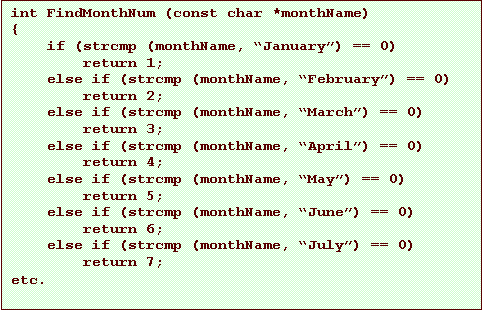
• What we basically need to do is:
– compare the entered month name with each month name that we know
– when we find a match, we know which number it is.
– we have a few different ways we can do this:
• I’ll show you with an if statement, and a loop
example 1
example 2
![Text Box: int FindMonthNum (const char *monthName)
{
char *month[] = {“January”, “February”, “March”,
“April”, “May”, “June”, “July”, “August”,
“September”, “October”, “November”, “December”};
for (i = 0; i < numMonths; ++i)
if (strcmp (monthName, month[i]) == 0)
return i+1;
return 0;
}](./Lecture27_files/image005.gif)