Lecture #24: Arrays 2
December 1, 1999
Bob Pitha
bpitha@cs.ucsd.edu
http://www-cse.ucsd.edu/classes/fa99/cse5a
our story so far…
• On Monday we began talking about arrays
• An array is a group of one or more adjacent things in memory
– they are all the same type
• any of the 7 basic data types
• pointers
• arrays (we won’t tackle this yet)
• other things we haven’t learned about
array recap: array declarations
• We have to declare an array variable just like any other variable
type
name[size];
type
name[size] = { initializer
list
};
type
name[] = { initializer list };
– common elements:
• type: the data type of each element of the array
• name: the name of the variable we are declaring
• size: either explicit or implicit, it’s the number of elements
array recap: array definitions
• As with other declarations, a defining declaration will reserve storage
– this will allocate an adjacent block of memory large enough to store all elements of the array
– all of the declarations we’ve seen (and probably will see) have been definitions
array declaration examples
• Some examples of array declarations
double coordinate[3];
• this defines an array named coordinate
– each element is a double
– it reserves space for 3 elements
int frequency
[26];
• this defines an array named frequency
– each element is an int
– it reserves space for 26 elements
int *pointer
[6];
• this defines an array named pointer
– each element is a pointer to an int
– it reserves space for 6 elements
array recap: using arrays
• We can only do two things with arrays:
– refer to an element of the array
• we can then do lots of different things with that element
– get a pointer to the first element of the array
array recap: subscript expression
• We refer to an array element using a subscript expression
– array_name[index]
– details
• the index is any expression with integral value
• the index value selects a specific element of the array
– the first element is index 0
• a subscript expression is usually an lvalue
– which means we can assign a value to an array element
array recap: subscript expression
• Given the following declaration:
int a[8];

– it’s not illegal to use an index off the end of the array
• but it may have undefined results, since it will mean you’re referring to memory that isn’t part of the array
• we’ll see why this is legal a little later…
subscript expression examples
• So remember our example declarations:
double coor[3];
int frequency
[26];
int *pointer
[6];
– the following code is legal:
printf (“(%f,
%f, %f)\n”, coor[0], coor[1], coor[2]);
for (i=0;
i<26; ++i)
frequency[i] = 0;
pointer[3] =
&frequency[12];
array recap: array name as pointer
• In many contexts, using the array name by itself gets you a pointer to the first element
int frequency
[26];
int *pointer
[6];
pointer[3] =
&frequency[12];
pointer[2] = frequency;
so now back to our example
![Text Box: #include <stdio.h>
int InputScores (double *);
void PrintStats (double *, int);
int main (void)
{
double scores[250];
int numScores;
printf (“Scores: a program to compute grade statistics.\n”);
printf (“Enter all scores, finish with –1:\n\n”);
numScores = InputScores (scores);
PrintStats (scores, numScores);
}](./Lecture24_files/image003.gif)
•
Note that we call the two functions with the argument scores
passing arrays
• It is perfectly legal to put an array name into a list of arguments to a function
– this is a value context
– therefore, the array name expression becomes a pointer to the first element of the array
– note that the prototype for InputScores looks like this:

• So when we pass an array into a function, we’re really just passing a pointer to the beginning of the array
passing arrays
• Note the “difference” between passing a scalar variable and an array
– up to now, when we put a variable name in an argument list, its value was passed to the function
– with an array, what gets passed is a pointer
• There’s no discrepancy here, really…
– remember The Array Rule:
•
In a value context, the name of an array of
type “array N of T” becomes a “pointer to T”
– so in a manner of speaking, the “value” of the variable is the pointer to the first array element.
functions with array arguments
• We’ve talked about passing arrays into functions, but what does it look like from the function side?
– The function gets a pointer as an argument.
• but we only know how to dereference a pointer to a single value
• how does the function access the whole array?
arrays and pointers
• Here’s where we start getting into the real overlap between arrays and pointers
– remember I told you The Rule:
•
In a value context, the name of an array of
type “array N of T” becomes a “pointer to T”
– and remember the syntax of the subscript expression
array_name [index]
– in fact, there’s nothing special about this use of the array name – it’s simply a value context too
say what?
• A subscript expression is really a pointer expression, not an array expression
– and to understand this, we have to delve into pointer arithmetic
pointers again
• So far, we have discussed three operators that deal with pointers:
– the “address-of” operator: &
– the dereference operator: *
– the assignment operator
• There are other pointer operators you can use, including:
– addition: +
– subtraction: -
pointer arithmetic
• The familiar arithmetic operators + and – can also be used with pointers
– but there are rules…
– I said that computer addresses are just numbers, but pointer arithmetic isn’t quite as simple as that…
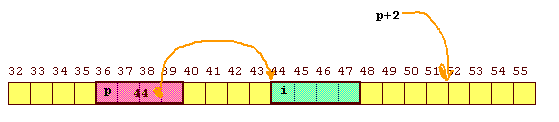
pointer addition
• One of the operands of + can be a pointer
– but then the other operand must be an integer
– and it doesn’t just add the integer to the address
• instead, it adds the integer times the size of the thing the pointer points to
– so given the declarations:
int i;
int *p =
&i;