Lecture #18: Review
November 12, 1999
Bob Pitha
bpitha@cs.ucsd.edu
http://www-cse.ucsd.edu/classes/fa99/cse5a
lectures
• Lecture 2: Computers and computer languages
– Basic terminology
– Computer numbering
• binary
• octal
• hexadecimal
– What is a computer program?
– Computer languages
• Lecture 3: How is programming like driving?
– That “driving directions” analogy
– Example program: “Hello, world!”
• Lecture 4: The C Language
– A second example program: printing numbers
• variables
• loops
– Introducing variables and data types
• identifiers/variable names
• why have data types?
• integer types
• Lecture 5: Data Types
– The 7 basic data types
– FtoC example program
• Lecture 6: More Data Types and Constants
– signed/unsigned data types
– constants
• numerical constants
• character constants (which are numbers, too!)
• escape sequences
• Lecture 7: Declarations
– variable declarations
– initialization
• Lecture 8: Operators
– operators and expressions
– expression concepts
• lvalues!!!
– conversions in expressions
– precedence and associativity
– arithmetic operators
• Lecture 9: More operators
– increment/decrement operators
– assignment operators
– relational operators
• Lecture 10: Operators, expressions, statements
– equality operators
– logical operators
– expressions
– statements
• expression statements
• compound statements
• Lecture 11: Statements 2
– selection statements: if-else
• Lecture 12: Statements 3
– the conditional expression
– selection statements: switch
– iteration statements (loops)
• while
• for
• Lecture 13: Statements 4
– iteration statements
• do-while
– jump statements: break and continue
• Lecture 14: Writing Programs
– interpreting a program
• multiplication table example
– writing a program
• printing prime numbers
• Lecture 15: Quiz answers and discussion
• Lecture 16: Functions 1
• Lecture 17: Functions 2
textbook sections
• Chapter 1: A Tutorial Introduction
– this isn’t necessary, but it does give some decent examples.
• Chapter 2: Types, Operators, and Expressions
– we’ve covered basically everything except the bitwise operators (§2.9)
– don’t worry about subjects we haven’t addressed in class:
• §2.3: strings and enumeration constants
• §2.4: const declarations
• Chapter 3: Control Flow
– we’ve covered the whole chapter
– it contains valuable information and examples
• they use getchar()
– §3.8 Goto and Labels
• this isn’t critical material, but it’s good to know
• Chapter 4: Functions and Program Structure
– §4.1 – 4.4
– §4.2 uses arrays in its example
exercises
• Consider trying the exercises in your text, especially:
– Chapter 1
• 1-1 – 1-5
– Chapter 2
• 2-2, 2-10
– Chapter 3
• 3-1
review questions
• These questions are just to help you review:
– What does the line #include <stdio.h> do for us?
– Why do we use comments?
– What are the largest and smallest values that can reliably be stored in a:
• char
• int
– What is the difference between the constants 6 and ‘6’?
– What are the two different kinds of division that the / operator can do? Under what circumstances does it perform each of them?
– Name at least two different uses for the semicolon in C
– what would the equivalent code, using a while loop, be for this example:

– What is the numeric value of the expression 3<4?
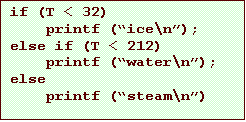
– Under what conditions will this code print “water”?
– What would this code print?
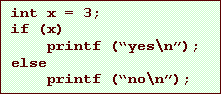
– What would this code print?(Caution: trick question!)
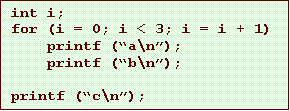
– What do these loops print?




– What is the difference between a function declaration (prototype) and a function definition?
– What is the difference between the prefix and postfix forms of the ++ operator?
– (trick question) What would the expression

do?
– Write a program to print the numbers from 1 to 10 and their squares, like this:

You should use a function to compute the squares of the numbers. It might have the following declaration:

– Write a program that prints a triangle, like this (using loops, not just a bunch of printf statements!):

– Write a function that computes and returns the average of five numbers, which are passed in as arguments. The function should be declared like this:

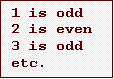
– Write a program that prints the numbers between 1 and 10, along with an indication of whether each is even or odd (you can use the % operator). Your output should look like this: