Lecture #16: Functions
November 8, 1999
Bob Pitha
bpitha@cs.ucsd.edu
http://www-cse.ucsd.edu/classes/fa99/cse5a
what’s a function?
• A group of declarations and statements that is assigned a name
– effectively, a named statement block
• A sub-program
– we
write our program by writing a function named main
– inside which we can use other functions
• which can themselves use other functions, and so on…
why use functions?
• They can break your problem down into smaller sub-tasks
– easier to solve complex problems
• They make a program much easier to read
– “abstraction”
• like printf, we just have to know what a function does without worry about the details of how it works
• Generalize a repeated set of instructions
– we don’t have to keep writing the same thing over and over
characteristics of functions
• Name
• Arguments
• Body
• Return value
function name
• Is an identifier
• This is how you refer to the function elsewhere in the program
function arguments
• These are variables whose values you specify every time you invoke the function
– so they can have different values each time
function body
• These are the declarations and statements that actually do the work
• Specified in the function definition
return value
• A function can optionally return a value.
• This value becomes the value of the function call expression
•
If a function doesn’t return a value, the return type
should be void
function declaration
• Just as with variables, functions can be declared
• The declaration contains:
– the function name
– the data types of the arguments
– the data type of the return value
function declaration vs. definition
• The definition is the actual function
– it has the function name
– it has the argument declarations
– it specifies the return type
– it has the statements that comprise the function body
• The declaration is just a reference to the function
– it has the function name
– it has the argument data types
– it specifies the return type
– it has no code
• no statements or declarations
what does the function declaration do?
• it enables you to call a function without having to know the definition
– remember when we used printf?
• we didn’t know how the function worked
• but the compiler needed to know that printf was actually a function
• the file stdio.h contains a declaration for printf
function definition is a declaration
• You need to declare a function before you can call it
– at least you do in order to adhere completely to the ANSI standard
• You can declare the function by:
– including a function prototype
– including the function definition
function prototype
• This is a fancy name for a function declaration that isn’t the function definition
• It must include:
– the return type
– the function name
– the data types of the arguments in parentheses
• optionally with names, but they’re ignored
– and a semicolon after the right parenthesis
an analogy
• When you buy a TV, you get a user’s manual
– that manual tells you how to change channels
• in case you’ve been living in a cave for the past 50 years
– once you’ve read the manual, I can tell you, “change to channel 7” and you know what to do
– or I can say, “change to channel 4”
• In this analogy:
– “change the channel” is the function
– the channel number is the argument
another analogy
• You know (or can learn) how to calculate the geometric area of an ellipse
– given the major and minor axes
• Once you know, all I have to do is give you the two values, and you give me back a number
• In this analogy:
– “calculate the area of an ellipse” is the function
– the lengths of the 2 axes are the arguments
– the area is the return value
function example

what does this function do?

• It takes a single argument
– an int
• It returns the value of that argument multiplied by two
– also an int
how might we call this function?

note this
• Variable names
– inside MultByTwo, the argument is named x
– when we call it, we pass a variable named i
– there is no correspondence between the name of what we pass in and what we call it inside the function
function call expression
• We now have a new expression: the function call
– the expression is evaluated by executing the statements in the function
– the value of the function call expression is determined by the first return statement encountered in the function
function call expression example
• So given the code:
i
= MultByTwo (37) + 4;
– the statement is an assignment expression statement
• operator
is =
• operands
are i
and the expression MultByTwo(37)
+ 4
– the sub-expression is an arithmetic expression
• operator
is +
• operands
are the expression MultByTwo(37)
and 4
– MultByTwo(37) is an expression
• it
is evaluated by calling the function MultByTwo, with the argument 37
function call expression example continued
• When the computer evaluates the expression
MultByTwo (37)
– it invokes the function:
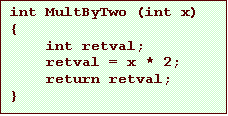
function call
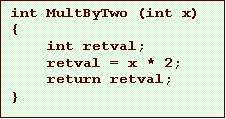
• The local variable x is set to the value of the argument
– which in this case was a constant, 37
– retval is set to 74
– the value 74 is returned, which means the value of the expression MultByTwo(37) becomes 74
expression evaluation
i
= MultByTwo (37) + 4;
• So the value of the expression
MultByTwo (37) + 4
becomes 78
• And this is what i gets set to
return statement
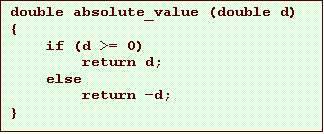
• This is the statement that causes the function to return a value
– it must return a value that can be converted into the data type specified as the function return value
• A function may have any number of return statements, but the first one encountered will end the execution of the function and return the value
return statement example
function arguments
• Each argument declares a local variable that is only accessible from inside the function
– its value is set using the value that is specified in the call
– it ceases to exist after the return statement is executed
• usually…
• Important concept here:
– the local variable inside the function is totally distinct from the variable whose value was used to call the function
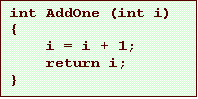
• so if the function changes the value of one of its arguments, it doesn’t affect the variable used to call the function
pass-by-value
• This is the term that means that function arguments are passed into the function by copying their values
– rather than giving the function direct access to the actual variables