Lecture #15
November 5, 1999
Bob Pitha
bpitha@cs.ucsd.edu
http://www-cse.ucsd.edu/classes/fa99/cse5a
let’s talk about the quiz
• Stats:
– average score: 15.5
– each question got answered correctly by someone
question 1
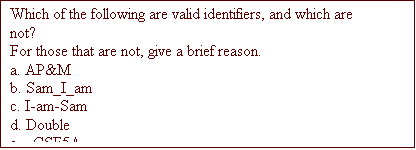
• Remember the rules for identifiers:
– Letters, digits, and underscore
– Can’t start with a digit
let’s talk a little more about identifiers
• Identifiers are just names you can use in your program
– they’re kind of a general-purpose set of rules for naming things
• variables
• functions
•  new data types
•
We haven’t covered these yet
data structures
|
We haven’t covered these yet |
• symbolic constants
valid identifiers
• There’s a difference between a legal identifier and one that can be used in a particular context
– legal means it just passes the simple rules for identifiers
– useable means the compiler will let you use it
• The main reason a legal identifier may not be used is that it’s already used in a way that would conflict
conflicting names
• For example, main is a perfectly valid identifier
– it’s all letters
– it doesn’t begin with a digit
• But I can’t name a variable main, because it would conflict with the function named main.
• Similarly, when your book says you shouldn’t name variables starting with an underscore, it’s not because it’s not a legal identifier
– it’s just that sometimes you’ll find that the name has already been used
so back to question 1…
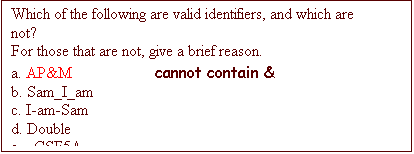
so back to question 1…
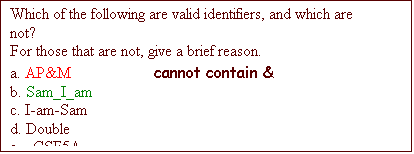
• It is perfectly legal to mix upper and lower case
– case-sensitive means that 2 identifiers are considered different even if they only differ by the case of one or more letters (i.e., i vs. I)
so back to question 1…
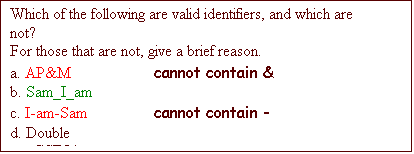
so back to question 1…
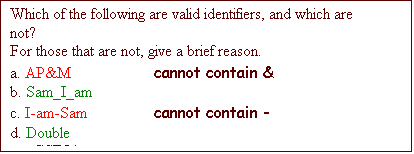
• There is a data type named double, which means it is a keyword that cannot be used as a variable
– but it’s still a valid identifier
– anyway, this is Double, not double.
so back to question 1…
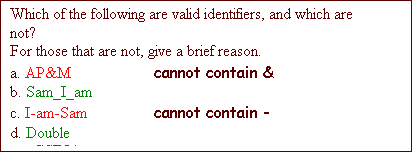
• This is a legal identifier
– just as your book says, it’s a good idea to avoid identifiers that begin with a single underscore
question 2

• There are some special-purpose computers that have other byte sizes, but these are rare. All common modern computers use an 8-bit byte.
question 3
question 4
|
|
||||||||||||
|
question 4
|
decimal |
binary |
hexadecimal |
|
10 |
1010 |
|
|
|
1111 |
|
|
|
|
2c |
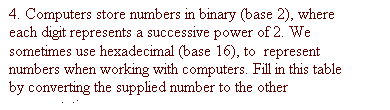
• Let’s look at these numbers that are already filled in…
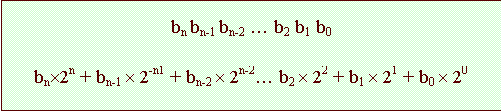
– so first, let’s review what we know about binary
question 4 – binary review
• So 1010 in binary is:
1*23 + 0*22 + 1*21 + 0*20
8 + 2
10
question 4
|
decimal |
binary |
hexadecimal |
|
10 |
1010 |
|
|
15 |
1111 |
|
|
|
|
2c |
• Similarly, 1111 in binary is:
1*23 + 1*22 + 1*21 + 1*20
8 + 4 + 2 + 1
15
question 4
|
decimal |
binary |
hexadecimal |
|
10 |
1010 |
a |
|
15 |
1111 |
|
|
|
|
2c |
• Now for some hex:
– remember the hex digits are
1 2 3 4 5 6 7 8 9 a b c d e f
• where a-f represent 10-15
– so this first one is easy: 10 in hex is a
question 4
|
decimal |
binary |
hexadecimal |
|
10 |
1010 |
a |
|
15 |
1111 |
f |
|
|
|
2c |
• And 15 is just f
question 4
|
decimal |
binary |
hexadecimal |
|
10 |
1010 |
a |
|
15 |
1111 |
f |
|
44 |
|
2c |
• Now going from hex to decimal:

– 2c is:
2*16 + c
32 + 12
44
question 4
|
decimal |
binary |
hexadecimal |
|
10 |
1010 |
a |
|
15 |
1111 |
f |
|
44 |
|
2c |
• Now the hard one: convert 44 to binary
– this essentially means expressing 44 as a sum of powers of 2
• so what powers of 2 can we sum up to make 44?
– What’s the largest power of 2 that is less than 44?
• 32 (25)
– in binary, therefore, 32 is 100000
question 4
|
decimal |
binary |
hexadecimal |
|
10 |
1010 |
a |
|
15 |
1111 |
f |
|
44 |
|
2c |
• So 44 is 25 + 12
– so we need to express 12 as a sum of powers of 2
– what’s the largest power of 2 that is less than 12?
• 8 (23)
• So 44 is 25 + 23 + 4
question 4
|
decimal |
binary |
hexadecimal |
|
10 |
1010 |
a |
|
15 |
1111 |
f |
|
44 |
101100 |
2c |
• So 44 is 25 + 23 + 4
– so we need to express 4 as a sum of powers of 2
–
4 is just 22
•
So 44 is 25 + 23
+ 22
– which means in binary, 44 is 101100
•
that is, 1*25 + 0*24
+ 1*23 + 1*22 + 0*21 +
0*20
a comment about conversions
• What’s the point of this?
– these were simple numbers.
– it helps to know simple hex/binary/decimal numbers
extra credit

• It turns out that when the order of one base is a power of the order of another (i.e., 16 is 24) it is very convenient to convert between them
– you only have to look at each group of 4 bits
• 4 bits represents a number from 0 to 15
• 1 hex digit represents a number from 0 to 15
question 5