Lecture #10: Operators, Expressions, and Statements
Bob Pitha
bpitha@cs.ucsd.edu
http://www-cse.ucsd.edu/classes/fa99/cse5a
equality operators
== !=
• Test whether operands are equal or not equal
• Return 1 or 0
precedence and associativity

equality operator issues
•
Don’t count on testing floating-point types with ==
– why?
• real numbers in the computer can differ by an insignificant amount
• == tests for exactly equal
– so instead, test the difference between them

important!
• Don’t confuse == with =

– the worst part is, this is legal C code; it just doesn’t do what you (probably) want
• the expression i = 0
– it sets the value of i to 0
– its value is 0
• the
expression i == 0
– doesn’t set the value of anything
– its value is 1 or 0 depending on whether i is 0
– This can cause bugs that are very hard to find!
logical operators
&&
||
• Logical AND and OR
(a && b) is true if both a and b are true
(a || b) is true if either a or b are true, or both.
• Evaluation stops when truth value is known
((a != b) && (c <= d))
precedence and associativity


expressions
what is an expression?
• Nobody has a good, clear definition.
• A sequence of operators and operands that has a value and/or does something interesting
• There are a bunch of types
how are expressions used?
• As operands in larger expressions
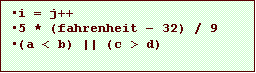
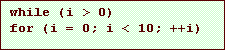
• As parts of statements
side effects in expressions
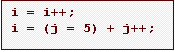
• Some operators have “side effects”
– change the value of their operands
• You must be careful not to combine side effects
– no expression should modify the same object twice
we’ve finally finished chapter 2!
• 2.1 Variable Names
• 2.2 Data types
• 2.3 Constants
• 2.4 Declarations
• 2.5 Arithmetic operators
• 2.6 Relational operators
• 2.7 Type conversions
• 2.8 Increment/decrement operators
• 2.10 Assignment operators
• 2.12 Precedence
statements
what’s a statement?
• A specification of some action to be performed
• Executed sequentially
what kinds of statements do we have?
• Expression statements
• Compound statements
• Selection statements
• Iteration statements
• Jump statements
what kinds of statements do we have?
•
Expression statements
• Compound statements
• Selection statements
• Iteration statements
• Jump statements
expression statements
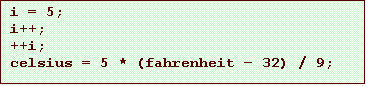
• Any expression can be a statement
– just stick a semicolon (;) on the end
– but they’re only evaluated for their side effects
• the expression’s value is ignored
expression statements
• Since the value is ignored, expressions that only have a value are not meaningful statements
– they’re not illegal, just useless
– some compilers will warn you about them
• the assumption is that you forgot something

• Special case: the null statement
– an empty statement – just a semicolon
– used when the syntax requires a statement, but you don’t want to do anything.

what kinds of statements do we have?
• Expression statements
•
Compound statements
• Selection statements
• Iteration statements
• Jump statements
compound statements
• Also called statement blocks
• Groups one or more statements into a unit
– syntactically equivalent to a single statement
– that means that wherever it’s legal to have a single statement, you can have a compound statement.
• Can have declarations and initializations
– but only at the beginning of a block
compound statement syntax
• Statements surrounded by braces { }
– no semicolon at the end
– although the statements and declarations in the block use semicolons as normal
use of compound statements
• Impossible to use C without using compound statements
• We’ve already seen them a lot