- a.
- yes, yes, no, no, no
- b.
- yes, yes, no, no, no
- c.
- no, no, no, no, no
- d.
- no, no, yes, yes, no
- e.
- yes, no, yes, no, yes
- f.
- yes, no, yes, no, yes
- a.
-
 (use case 3 of the master theorem)
- b.
-
 (use case 3 of the master theorem)
- c.
-
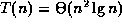 (use case 2 of the master theorem)
- d.
-
 (use case 3 of the master theorem)
of the master theorem)
(use case 3 of the master theorem)
of the master theorem)
- e.
-
 (use case 1
of the master theorem)
(use case 1
of the master theorem)
- f.
-
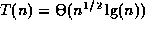 (use case 2 of the master theorem)
- g.
-
 (iteration method; see page 156 for details)
- h.
-
 . Note that you might iterate the
recurrence to figure out that this is the proper bound; the constant 1 is
added each time we iterate, so that we get
. Note that you might iterate the
recurrence to figure out that this is the proper bound; the constant 1 is
added each time we iterate, so that we get 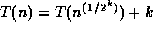 for
larger and larger k. This will stop once
for
larger and larger k. This will stop once  gets down to about
 , since at that point
  is about 1. Solving
 gives
gives  , which suggests that we'll add 1
about
, which suggests that we'll add 1
about  times before the problem size gets too small to crank
the recurrence anymore.
times before the problem size gets too small to crank
the recurrence anymore.
Use the substitution method to prove this bound is correct. First show that
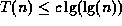 for n>2. For
the base case, pick c large so that this is satisfied for
for n>2. For
the base case, pick c large so that this is satisfied for  (we need this so that any recurrences that start with larger n (that
is, n>4 so that
(we need this so that any recurrences that start with larger n (that
is, n>4 so that  ) will eventually depend on this base
case, rather than falling through to some smaller n for which we don't
have any bound). Now, assume this bound holds for values less than n, and
show for n. Substituting into the recurrence, we get:
) will eventually depend on this base
case, rather than falling through to some smaller n for which we don't
have any bound). Now, assume this bound holds for values less than n, and
show for n. Substituting into the recurrence, we get:




Pick c>1, so that we can drop the
 term and get our desired
conclusion:
term and get our desired
conclusion:

So,
 .
.
Since we want a
 bound, we also need a lower bound on
  . We
want to show that
. We
want to show that 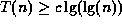 . Similar to the above, for the
base case
pick c small
enough so that this bound holds for
. Similar to the above, for the
base case
pick c small
enough so that this bound holds for  . Now, assume the bound
holds for values less than n and show for n. Substituting into the
recurrence:
. Now, assume the bound
holds for values less than n and show for n. Substituting into the
recurrence:




Pick c<1, so that we can drop the
 term and get our desired
conclusion:
term and get our desired
conclusion:

So,
 . Combining this with the above,
 .
.