 and
 satisfying
 ,
 .
Furthermore, the partition is nontrivial:
 .
CSE 101 Notes - Quicksort Correctness Proof
Refer to the QUICKSORT and PARTITION algorithms on page 154. This correctness proof will also apply to RANDOMIZED-QUICKSORT.
There are 2 parts to the proof. First, we show that QUICKSORT is correct, assuming that PARTITION is correct. Then, we verify the correctness of PARTITION.
First, assume that PARTITION is correct, defined as: it permutes its input and
returns q, such that for all and satisfying
,
.
Furthermore, the partition is nontrivial: .
The QUICKSORT correctness proof is by induction on size of the input array, n = r-p+1.
For the base case of  ,
 so that
QUICKSORT doesn't execute anything past line 1; it doesn't touch A.
This is correct, since an array with zero or one elements is trivially
already sorted.
Now, assume that QUICKSORT is correct for inputs of size less than n
(this is the induction hypothesis), and show it is correct for inputs of size
n. Since we are assuming PARTITION is correct and that it
returns a q satisfying  , both line 3 and line 4 make
recursive calls on arrays with sizes between 1 and n-1. We can thus
apply the induction hypothesis to these recursive calls, showing that
 and
 are
correctly sorted. So,
 is sorted in increasing order,
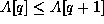 by the correctness of partition, and
 are sorted in increasing order. Thus,
 , the input
to QUICKSORT, is correctly sorted.
Now we show that PARTITION is correct. We start with two basic facts: that i and j stay in bounds and that the partition is nontrivial. Then we show that the partition is correct.
We show that i and j stay in bounds. Note that j is
decremented to r before it is ever used to access A, and i is
similarly incremented to p before it is ever used to access A. After
that point, the only changes to i and j are lines 5 and 7, which decrement
j and increment i: so A is always indexed with  and
 . This shows that i and j each respect one of the two boundaries
of the array.
For the other boundary,
consider the first pass through PARTITION's outer loop. i stops at
i=p since  , triggering the until condition in line 8.
When decrementing in lines 5-6, j might stop (by triggering the
until condition at some j>p, but if it doesn't then it certainly
stops at j=p since
 triggers the until condition in line 6.
Thus, on the first time that line 9 is reached, i=p and
 .
If j<r after this first pass,
then  (or else the until in line 6 would have
been triggered when j=r). Otherwise, j=r when line 9 is reached:
i < j since A has at least 2 elements, so the exchange at line 10
is performed and
 now holds x. In either of these cases,
 after the first pass through the main loop.
If the exchange is not performed on the first pass (because i=j when
line 9 is reached), then  as was the case in the original input.
Otherwise, line 10 places into
 the contents of
 , where
 by the until condition in line 6. In either of these
cases,
 after the first pass through the main loop.
After this first pass through the loop,
any subsequent pass will continue incrementing i
and decrementing j, such that i>p and j<r for these.  and
 will therefore not be touched by line 10 again, unless we reach a state
where j=p or i=r. Before the first time where we reach such a state,
note that j cannot be decremented below p, because
 (as
shown above) triggers
the until in line 6. Similarly, i cannot be incremented above
r, because
 triggers the until in line 8. The
first time when j=p, since
 ,
 and PARTITION terminates.
Similarly, the first time i=r, since
 ,
 and PARTITION
terminates. Thus, after the first pass, i cannot move past r and
j cannot move past p. As noted above, i will never be used to
access A when i < p, and j will never be used when j>r. Combining
these, we see that i and j stay in-bounds.
Note that, since each pass through the main loop of PARTITION, i gets incremented at least once (and is never decreased) and j gets decremented at least once (and is never increased), this shows that PARTITION must eventually terminate.
Now, we show that the partition is nontrivial: we have  upon
termination by the above argument, so the lower partition is of size
at least 1. But we need j<r upon termination to show that the
lower partition does not contain all n elements. If after the first
pass, j < r, then the j that eventually gets returned will be less
than r, since j is only decremented after that first pass.
Otherwise, j=r after the first pass. i=p after the first pass, as
discussed above, so i<j since r>p. Thus, a second pass is
executed, and j gets decremented at least once
in line 5, yielding j<r, and again the
j that eventually gets returned will be less than r. In either case, we
get a nontrivial partition with j<r upon termination of PARTITION.
Finally, we need to show that the partition that gets returned is correct. We do this by induction on the number of passes through the main loop, using an invariant that stays true each time through the loop, and upon termination yields our desired conclusion of correctness. The invariant here specifies that all elements that i has already swept pass are correctly on the low side of the partition, and all elements that j has already swept pass are correctly on the high side of the partition. In particular, we show that the following invariant holds just before the first pass through the main loop (between lines 3 and 4), and then after each pass through the main loop (between lines 10 and 11, so that we can show it holds before returning the last time through the main loop):

The last line of the invariant says that, if we have had at least one pass through the main loop, but this was not the final pass through the loop, then the correctness condition also holds at the current values of i and j.
For the base case, note that after line 3 but before we have executed the main loop the first time, the input is unchanged (so it is a permutation of the input), and there are no values of k for which the remainder of the invariant needs to hold; so the invariant is true at that point.
Now show that the invariant holds at the end of a pass through the main loop, assuming it held after the previous pass through the main loop (this assumption is the inductive hypothesis). First, since i and j never get out of bounds, and exchange operations are the only changes to A, A remains a permutation of the input. This establishes that the first line of the invariant remains true.
Now, say that i started at  and j at
 at the start of this
pass. So
 for
 by the inductive hypothesis,
and similarly
 for
 . By the conditions
on the until's and the fact that i and j remain in bounds
(shown above), we have
 for
 and
 for
 .
Combining the above,  holds for the entire range
 ,
and
 for
 ; this establishes that the second
and third lines of the invariant hold after this pass through the
main loop. If j<i at the end of this pass,
then we are done because the last line of the invariant no longer
applies. Otherwise, the until stopping conditions, followed by the
exchange in line 10, give
 and
 after the
exchange, so the last line of the invariant holds in this case.
Since each pass through the main loop preserves the invariant, the invariant
is true upon termination of PARTITION, which returns q=j. Since  at this point,
 for all k < q by the invariant. Also
by the invariant,
 for all k > q. By the until
termination condition in line 6 on the last pass through the loop, j stops
at a point satisfying
 : thus
 as well. Together
with the facts that i and j stay in bounds, that PARTITION terminates,
and that the partition is nontrivial, this completes the proof that
PARTITION is correct as defined above.