 with
indices i and j ranging from 1 to n; i specifies the row and
j specifies the column of the matrix.
with
indices i and j ranging from 1 to n; i specifies the row and
j specifies the column of the matrix.
L(A,n)1 for
to n
2 do

3 for
to n
4 do

5 if t = 2n
6 then return i
7 return NULL
- (a)
- When n=3 and
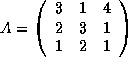 , what does L(A,n) return?
- (b)
- Give the worst-case running time using
 notation.
- (c)
- Give the best-case running time using
 notation.
 is 2, because it occurs 3 times in the sequence, which
is more frequently than any other element.
is 2, because it occurs 3 times in the sequence, which
is more frequently than any other element.
Write an algorithm (using pseudocode)
to find the mode of a sequence A of integers. Your
algorithm should take  time, where n is the number of
elements of A. If necessary, you may make calls to
any of the algorithms we have
discussed in class.
time, where n is the number of
elements of A. If necessary, you may make calls to
any of the algorithms we have
discussed in class.
MERGE-SORT-THREE(A,p,r)1 if p<r
2 then

3 MERGE-SORT-THREE(A,p,a)
4 MERGE-SORT-THREE(A,a,2a)
5 MERGE-SORT-THREE(A,2a,r)
6 MERGE(A,p,a,2a)
7 MERGE(A,p,2a,r)
Recall that MERGE(A,i,j,k) merges the sorted elements from i to j, and the sorted elements from j+1 to k, into a single sorted sequence from i to k.
Write a recurrence for the running time of MERGE-SORT-THREE on a sequence A
consisting of n elements, and solve it
to obtain the running time using  notation.
RANDOMIZED-SELECT(A,p,r, i)1 if p=r
2 then return A[p]
3
RANDOMIZED-PARTITION(A,p,r)
4

5 if

6 then return RANDOMIZED-SELECT(A,p,q,i)
7 else return RANDOMIZED-SELECT(A,q+1,r,i-k)
In class, we showed that RANDOMIZED-PARTITION is correct:
it permutes its input and
returns q, such that for all  and
and  satisfying
 ,
,
 .
Furthermore, the partition is nontrivial:
.
Furthermore, the partition is nontrivial:  .
.
Using the correctness of RANDOMIZED-PARTITION, show that RANDOMIZED-SELECT correctly returns the i'th order statistic among elements p through r of sequence A.
MATRIX-CHAIN-ORDER(p)1
length
-1
2 for
to n
3 do

4 for
to n
5 do for
to n-l+1
6 do

7

8 for
to j-1
9 do

10 if

11 then

12

13 return m and s
Upon termination,  contains the minimum number of multiplications
required to multiply the matrices in the given chain p.
Modify the algorithm so that it computes an additional matrix a, such that
upon termination,
contains the minimum number of multiplications
required to multiply the matrices in the given chain p.
Modify the algorithm so that it computes an additional matrix a, such that
upon termination,  contains the number of distinct
ways there are to obtain this minimum number of multiplications. That is,
you want to compute the number of different ways there are to parenthesize
the chain of matrices and still obtain the minimal number of multiplies.
contains the number of distinct
ways there are to obtain this minimum number of multiplications. That is,
you want to compute the number of different ways there are to parenthesize
the chain of matrices and still obtain the minimal number of multiplies.
If you want, you can just specify modifications to the pseudocode, but be precise (for example, ``modify line 3 to read... include the following line between lines 12 and 13 so that it is within the scope of the then on line 11...'').