- (a)
- 2. Explanation: This algorithm finds the first row whose elements add up to 2n. It returns NULL if there is no such row. L(A,n) returns 2, since the second row's elements sum to 6 = 2n.
- (b)
-
 .
Explanation: The outer for loop goes through at most n iterations.
The inner for loop
always goes through n values of j, taking constant time in lines
4-6 each iteration. So the inner loop uses a total of
.
Explanation: The outer for loop goes through at most n iterations.
The inner for loop
always goes through n values of j, taking constant time in lines
4-6 each iteration. So the inner loop uses a total of  time to complete its execution. In the worst case, when the outer loop
iterates n times, executing this complete inner loop each time, total
time is
time to complete its execution. In the worst case, when the outer loop
iterates n times, executing this complete inner loop each time, total
time is  .
.
- (c)
-
 .
Explanation: In the best case, the very first row sums to
2n, so that we return before trying any other values of i. We
only execute the inner loop once, for a total of
.
Explanation: In the best case, the very first row sums to
2n, so that we return before trying any other values of i. We
only execute the inner loop once, for a total of  time.
time.
MODE(A)1 MERGE-SORT(A,1,length
)
2

3

4

5 for
to

6 do if

7 then

8 if d>m
9 then

10

11 else

12

13 return l
Explanation: We can find the mode by sorting the sequence: then, all duplicates will be next to each other, so that we can easily count how many times each element occurs. In the algorithm above, c holds the current element for which we are counting number of occurrences, d holds the number of occurrences of this element so far, m holds the maximum number of occurrences of any element so far, and l holds this maximally-occurring element.
Line 1, MERGE-SORT, takes  time, and the remainder
of the algorithm loops through the elements once, spending constant time
on each, for a total of
time, and the remainder
of the algorithm loops through the elements once, spending constant time
on each, for a total of  time. So, total time is
  as required.

Using the master method, case 2 applies, since 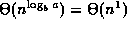 , which is the same as
  here. The solution given by
case 2 is:
here. The solution given by
case 2 is:

Explanation:
Let  be the time to sort a sequence of length n.
Lines 1-2 take constant time. Each of lines 3-5 is a recursive call
on exactly
be the time to sort a sequence of length n.
Lines 1-2 take constant time. Each of lines 3-5 is a recursive call
on exactly  elements (this is always possible since n is
assumed to be a power of 3). Lines 6-7 take
elements (this is always possible since n is
assumed to be a power of 3). Lines 6-7 take  time, as shown
in class. This gives the recurrence:
time, as shown
in class. This gives the recurrence:

The master theorem is then applied with a=3, b=3, and  .
Since
.
Since  ,
, 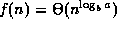 , so
we are in case 2 of the master theorem, which tells us:
, so
we are in case 2 of the master theorem, which tells us:

Now assume that RANDOMIZED-SELECT is correct for less than n elements
(this is the induction hypothesis), and show it is
correct for n elements (with n>1 now). Line 1's check fails, so execution
continues on line 3. By the correctness of RANDOMIZED-PARTITION,  holds the smallest k elements of
  after line 3,
and
after line 3,
and  holds the n-k largest elements. Since the
partition is nontrivial,
holds the n-k largest elements. Since the
partition is nontrivial,  ,
so the recursive calls on lines 6-7 are on fewer than n
elements and therefore return correct values by the induction
hypothesis. We are looking for the i'th smallest
element of
,
so the recursive calls on lines 6-7 are on fewer than n
elements and therefore return correct values by the induction
hypothesis. We are looking for the i'th smallest
element of  . So, if
 then this is the i'th smallest element among the k
smallest elements of
then this is the i'th smallest element among the k
smallest elements of  :
in this case, the recursive call on line 6
returns this value. Otherwise, the i'th smallest element
is the i-k'th smallest among the n-k largest elements of
:
in this case, the recursive call on line 6
returns this value. Otherwise, the i'th smallest element
is the i-k'th smallest among the n-k largest elements of
 : line 7 correctly returns this value in this case.
By induction, RANDOMIZED-SELECT is correct for all values of n.

Insert the following line between lines 11 and 12:

Insert the following two lines between lines 12 and 13; the else here is attached to the if on line 10:
else if
then

Finally, change line 13 to be:
13 return m and s and a
Explanation: Initialize each  to one since there is only one
way to parenthesize a single matrix. When a new minimum number of
multiplications is found, initialize the corresponding a entry with
the total number of ways to combine a minimal parenthesization on the
left side of the split with a minimal parenthesization on the right side. The
total number of ways to combine these is the product of the numbers of optimal
parenthesizations on either side of the split. When a different split
yields the same number of multiplications as the minimum, increase the
corresponding a count by this product of the numbers on either side of
the split.
to one since there is only one
way to parenthesize a single matrix. When a new minimum number of
multiplications is found, initialize the corresponding a entry with
the total number of ways to combine a minimal parenthesization on the
left side of the split with a minimal parenthesization on the right side. The
total number of ways to combine these is the product of the numbers of optimal
parenthesizations on either side of the split. When a different split
yields the same number of multiplications as the minimum, increase the
corresponding a count by this product of the numbers on either side of
the split.