 algorithm. We want to do better using a
divide-and-conquer method. We assume the integers are represented in
binary.
algorithm. We want to do better using a
divide-and-conquer method. We assume the integers are represented in
binary.
CSE 101 Notes
Large Integer Multiplication Using Divide-and-Conquer
The ``grade school'' algorithm for multiplying n-digit integers x and
y multiplies every digit in x by every digit in y, yielding a
algorithm. We want to do better using a
divide-and-conquer method. We assume the integers are represented in
binary.
For the
``divide'' step, we split each binary integer into two roughly
equal-sized parts, each containing about half of the bits of the original:
one part contains the high order bits, and the other part contains the
low order bits. Specifically,
if x and y have n bits, we let  and divide x into its low-order m
bits (
and divide x into its low-order m
bits ( ), and its high-order n-m
bits (
), and its high-order n-m
bits ( );
);  and
and  are defined similarly.
These are given by
are defined similarly.
These are given by  ,
,  , and similarly for y. These operations
can be implemented
by zeroing x's low-order bits and shifting the remaining bits
down to get
, and similarly for y. These operations
can be implemented
by zeroing x's low-order bits and shifting the remaining bits
down to get  , and by simply zeroing x's high-order
bits to get
, and by simply zeroing x's high-order
bits to get  . This shifting and zeroing of bits can be done in
linear time in the number of bits, so this ``divide'' step takes time
linear in n.
. This shifting and zeroing of bits can be done in
linear time in the number of bits, so this ``divide'' step takes time
linear in n.
Note that this decomposition is such that we have:

and

So that:

This specifies the product xy that we want, in terms of products of smaller
integers - these smaller products can be computed with recursive calls.
The above formula for xy makes it look as though we need to do four
recursive calls (one each for  ,
,  ,
,  ,
and
,
and  ) - but if we write down that straightforward
divide-and-conquer algorithm we get a
) - but if we write down that straightforward
divide-and-conquer algorithm we get a  method that is
no better than the ``grade school'' algorithm. But, we can do better
than this.
method that is
no better than the ``grade school'' algorithm. But, we can do better
than this.
First, do two recursive calls
to compute  and
and  . Now, note that

so that we can compute this product with one additional multiply, and then get the remaining term we need:

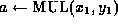
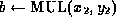
without doing any additional multiplies. That is, we have done three multiplies (plus some additions, which only take linear time in the number of bits), and we have obtained all the information we need to compute xy according to the formula above. This is given in detail in the algorithm below.






The complete running time analysis is a bit tricky, so let's do a
rough analysis first to get some idea of the running time. Roughly,
for integers of size n, we decompose them into integers of size
 and do 3 recursive calls plus a linear amount of extra
work (using linear-time shift, bit-zeroing, and addition operations as
discussed above).
Calling our approximately analyzed time
and do 3 recursive calls plus a linear amount of extra
work (using linear-time shift, bit-zeroing, and addition operations as
discussed above).
Calling our approximately analyzed time  , this would give

Using the
master theorem for recurrences (page 62 of the text): we have
b=2, a=3, and  is
is  . So,
. So, 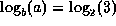 .
Since
.
Since  is about
  , we have that
 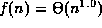 is
is
 for (picking a somewhat arbitrary value)
 , and therefore we are in case 1 of the master theorem, and

Unfortunately, when computing a sum of two  bit integers, such
as
bit integers, such
as  , carry may result in a sum that has
  bits
rather than just
bits
rather than just  .
Thus, some subproblem sizes are a little larger than the above analysis
suggests. Simplify the analysis by assuming that ALL subproblems are of
size
.
Thus, some subproblem sizes are a little larger than the above analysis
suggests. Simplify the analysis by assuming that ALL subproblems are of
size  (which doesn't change the asymptotic running time,
and which can be easily achieved by padding subproblems with an extra leading
zero bit, if necessary). Then our actual running time is
(which doesn't change the asymptotic running time,
and which can be easily achieved by padding subproblems with an extra leading
zero bit, if necessary). Then our actual running time is

We solve this using an
intermediate function  , which we define to be equal to
 . Now,
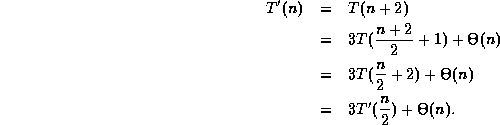
Taking the first and last lines of this, we have

so 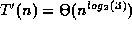 by the analysis in the above paragraph.
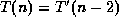 by the definition of
  , so
, so
