 below takes instance
 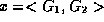 and
certificate y. Assume the graphs are specified by their connectivity matrices
and
certificate y. Assume the graphs are specified by their connectivity matrices
 and
and  (for a graph with n vertices, connectivity matrix
E is an n by n matrix with binary entries
(for a graph with n vertices, connectivity matrix
E is an n by n matrix with binary entries
 : a 1 indicates the presence of an edge between vertices i and j,
and 0 indicates absence of an edge).
If the two graphs are isomorphic, then there will be some way to rename
the vertices of
: a 1 indicates the presence of an edge between vertices i and j,
and 0 indicates absence of an edge).
If the two graphs are isomorphic, then there will be some way to rename
the vertices of  so that its connectivity matrix is identical to
that of
so that its connectivity matrix is identical to
that of  . If the two graphs are not isomorphic, there will be
no such renaming. So, if
. If the two graphs are not isomorphic, there will be
no such renaming. So, if  in instance x has n vertices, we
define certificates y for this instance to encode a permutation
in instance x has n vertices, we
define certificates y for this instance to encode a permutation
 of the vertex indices 1 through n; this permutation is used to
reorder the vertices in
of the vertex indices 1 through n; this permutation is used to
reorder the vertices in  , and the verifier checks if this reordering
makes the connectivity matrix identical to that of
, and the verifier checks if this reordering
makes the connectivity matrix identical to that of  .
.
A
1 if number of vertices in

number of vertices in

2 then return 0
3 for
to n
4 for
to n
5 if

6 then return 0
7 return 1
Lines 5-6 take constant time, and are executed  times, for a total
running time of
times, for a total
running time of  , which satisfies the requirement that the
verifier's running time be polynomial.
, which satisfies the requirement that the
verifier's running time be polynomial.
If the graphs are isomorphic, then they have the same number of vertices,
so the verifier reaches line 3.
Then,
there is some certificate y that contains the renumbering of the
vertices in  that makes the connectivity matrices identical, so that line 6
doesn't return and line 7 is reached, returning 1. If the graphs
are not isomorphic, then either they have a different number of
vertices (causing A to return 0 on line 2), or they have the
same number but for every certificate y, the connectivity matrices
remain different and the verifier returns 0.
that makes the connectivity matrices identical, so that line 6
doesn't return and line 7 is reached, returning 1. If the graphs
are not isomorphic, then either they have a different number of
vertices (causing A to return 0 on line 2), or they have the
same number but for every certificate y, the connectivity matrices
remain different and the verifier returns 0.
The verifier is correct and runs in polynomial time, so GRAPH-ISOMORPHISM is in NP.
 . If this is
satisfied, the verifier returns 1. If not, it returns 0.
. If this is
satisfied, the verifier returns 1. If not, it returns 0.
The verifier need only do a matrix multiply, which requires polynomial time. If there is a solution x to the inequality, then the certificate Y containing that x will cause the verifier to output 1. Otherwise, there is no solution so there is no certificate Y that makes the verifier output 1. Since the verifier is correct and takes polynomial time, the problem is in NP.
To show the problem is also NP-hard, we reduce 3-CNF-SAT to it. Given a 3-CNF
formula  with n variables,
we build an instance of
0-1 INTEGER PROGRAMMING, also with n variables - the same
variables that appear in P. The instance of 0-1 INTEGER
programming will have k inequalities (so A is a
k by n matrix). Each inequality is satisfied if the
corresponding clause in P is satisfied. To achieve this,
say we have a clause
with n variables,
we build an instance of
0-1 INTEGER PROGRAMMING, also with n variables - the same
variables that appear in P. The instance of 0-1 INTEGER
programming will have k inequalities (so A is a
k by n matrix). Each inequality is satisfied if the
corresponding clause in P is satisfied. To achieve this,
say we have a clause

where literal  is either variable
  or its negation
 , and similarly for
 and
and  .
.
To see how to get a corresponding inequality, say we
have the clause  .
We want to check that at least one of
.
We want to check that at least one of  ,
,  , and
, and
 (accounting for
  's and
  's negation)
is equal to 1.
So, we check that
's negation)
is equal to 1.
So, we check that  . Rewriting
in a form appropriate to 0-1 INTEGER PROGRAMMING,
. Rewriting
in a form appropriate to 0-1 INTEGER PROGRAMMING,
 .
.
To do this in general, let  be +1 if
variable
be +1 if
variable  appears negated, and -1 if it
appears in unnegated form (note the sign reversal, which is
needed because the inequalities are
appears negated, and -1 if it
appears in unnegated form (note the sign reversal, which is
needed because the inequalities are  rather than
  ),
and similarly for
),
and similarly for  and
and  .
Let g be the number of variables
in this clause that appear in negated form. Then the
corresponding inequality is:
.
Let g be the number of variables
in this clause that appear in negated form. Then the
corresponding inequality is:

If this inequality is satisfied by a 0-1 assignment to
 ,
,  , and
, and  , then the corresponding
clause of P has value 1 because at least
one of its literals has value 1. Otherwise, the corresponding
clause in P has value 0.
, then the corresponding
clause of P has value 1 because at least
one of its literals has value 1. Otherwise, the corresponding
clause in P has value 0.
The matrix A consists of one row per inequality. The row
has a zero entry for each variable not appearing in the
inequality, and the coefficients  ,
,  , and
, and  given above for the variables
  ,
,  , and
, and  that
do appear in the inequality. The corresponding row of the column
vector b contains the value g-1 given above.
that
do appear in the inequality. The corresponding row of the column
vector b contains the value g-1 given above.
This reduction is straightforward to compute, requiring only linear time in the number of variables to translate each clause into an inequality, and polynomial time overall to do this for all k clauses.
Given the 0-1 INTEGER PROGRAMMING instance built in this way, if it has a solution x, then each clause's inequality is satisfied, so the value of each clause is 1 and the original instance of 3-CNF-SAT is satisfiable. If the original 3-CNF-SAT instance has a satisfying assignment to its variables, this assignment gives each of its clauses value 1 and also satisfies the corresponding inequalities - so the 0-1 INTEGER PROGRAMMING instance has this same solution.
So, the reduction is correct, showing that 0-1 INTEGER PROGRAMMING is NP-hard. Since it is also in NP, it is NP-complete.
This verifier takes linear time in the number of vertices. If there is a simple cycle with at least k vertices, then passing that cycle as a certificate causes the verifier to output 1. Otherwise, no certificate contains a valid cycle with at least k vertices, so the verifier always outputs 0 for this instance. Since the verifier is correct and takes polynomial time, the problem is in NP.
To show the problem is NP-hard, we reduce HAM-CYCLE to it.
Given a graph G that is an instance of HAM-CYCLE, define
an instance <G,k> of LONGEST SIMPLE CYCLE containing the same
graph  , and k=|V|, the number of vertices in G.
This reduction involves only simple copying and counting, so it takes polynomial time.
Now, if graph G contains a Hamiltonian cycle, then this cycle is a simple cycle with |V| vertices, so the correct decision on the instance of LONGEST SIMPLE CYCLE is 1. If there is no Hamiltonian cycle, then there is no simple cycle with |V| or more vertices (simply by the definition of Hamiltonian cycle), so the correct decision on the instance of LONGEST SIMPLE CYCLE is 0.
So, the reduction is correct and takes polynomial time, showing that LONGEST SIMPLE CYCLE is NP-hard. Since it is also in NP, it is NP-complete.
 G contains an independent set with at least k vertices
  .
.
First show that this problem is in NP, by giving a polynomial-time
verifier. This is similar to the verifier for CLIQUE. The verifier
takes an instance  and a certificate y consisting of a set of k
vertices. For each pair of vertices in y, we check each edge and
see that it does not go between that pair of vertices. if this
check passes for all pairs in y and all edges, the verifier outputs 1.
Otherwise it outputs 0.
and a certificate y consisting of a set of k
vertices. For each pair of vertices in y, we check each edge and
see that it does not go between that pair of vertices. if this
check passes for all pairs in y and all edges, the verifier outputs 1.
Otherwise it outputs 0.
The verifier examines at most  pairs of vertices, and at
most E edges for each pair, so total time is polynomial:
pairs of vertices, and at
most E edges for each pair, so total time is polynomial:  .
.
If there is an independent set with at least k vertices, then a certificate containing any k of its vertices will cause the verifier to output 1. Otherwise, if there is no such independent set, no set of k vertices passes the independent-set check, so the verifier outputs 0 for all certificates. Since the verifier is correct and takes polynomial time, the problem is in NP.
To show the problem is NP-hard, we reduce from CLIQUE. Given an instance
<G,k> of CLIQUE, we construct an instance  of INDEPENDENT SET.
 is constructed from G by inverting the connectivity matrix:
  contains the same vertices in G, and for each pair of vertices i,j,
 has the edge
  if G does not have it, and
  does not have the edge
  if G does have it.
Now, if G has a clique with at least k vertices, then there is a
subset of k vertices in G such that each pair in this subset has
an edge between them. So, in  , each pair of vertices in this subset does
not have an edge between them: this subset of vertices is an
independent set of size k in
, each pair of vertices in this subset does
not have an edge between them: this subset of vertices is an
independent set of size k in  . In the other direction, if
 has an independent set with at least k vertices, there is a
subset of k vertices in
has an independent set with at least k vertices, there is a
subset of k vertices in  such that each pair in this subset
does not have an edge between them. So, each such pair of vertices
in this subset does have an edge between them in G, so this
subset is a clique of size k in G.
such that each pair in this subset
does not have an edge between them. So, each such pair of vertices
in this subset does have an edge between them in G, so this
subset is a clique of size k in G.
This shows that the reduction is correct. Inverting the connectivity matrix takes only linear time in the number of edges, so the reduction takes polynomial time. So, INDEPENDENT SET is NP-hard. Since it is also in NP, it is NP-complete.
(b) Given an instance <G,k> of INDEPENDENT SET, let ``black box'' B return the correct decision on this instance. The following algorithm finds the maximum-size independent set by first determining how many vertices it contains (by trying each threshold k to find the largest threshold for which there is still an independent set). It then finds the vertices in the independent set by temporarily deleting vertices. If deleting a vertex causes the size of the maximum independent set to decrease, then that vertex must be in the independent set. If it doesn't cause the size of the maximum independent set to decrease, then that vertex can be permanently deleted, yielding a subproblem of reduced size. Below, MAX-I-SIZE returns the size of the maximum independent set, and MAX-I returns the actual maximum independent set.
Let G-v denote the graph obtained by deleting vertex v from G's vertices, and deleting all edges connected to v from G's edges.
MAX-I-SIZE
1 for
to |V|
2 if

3 then return k-1
4 return |V|
MAX-I
1
MAX-I-SIZE

2
first vertex in G
3 if MAX-I-SIZE
=s
4 then return MAX-I

5 else return
MAX-I

Counting calls to B as a single step,
each call to MAX-I-SIZE takes  time. A call to MAX-I on a
graph with |V| vertices takes
time. A call to MAX-I on a
graph with |V| vertices takes  time for two calls to
MAX-I-SIZE, and also does a call to MAX-I on a graph with |V|-1
vertices. Deleting a vertex from a graph can be done in
time for two calls to
MAX-I-SIZE, and also does a call to MAX-I on a graph with |V|-1
vertices. Deleting a vertex from a graph can be done in  ,
since there are at most
,
since there are at most  edges in the graph; the time for MAX-I
also includes this time. Letting n=|V|, this yields the recurrence:
edges in the graph; the time for MAX-I
also includes this time. Letting n=|V|, this yields the recurrence:


by iteration. So,  , which is polynomial. Note that this
could be improved: binary search can cut the time required by MAX-I-SIZE,
and a carefully chosen data structure can reduce the time required to
delete a vertex. But for purposes of this problem, all that matters is
to obtain a polynomial-time algorithm.
, which is polynomial. Note that this
could be improved: binary search can cut the time required by MAX-I-SIZE,
and a carefully chosen data structure can reduce the time required to
delete a vertex. But for purposes of this problem, all that matters is
to obtain a polynomial-time algorithm.