Notes on Problems for Quiz 1 (10/3/97) from Schaum:
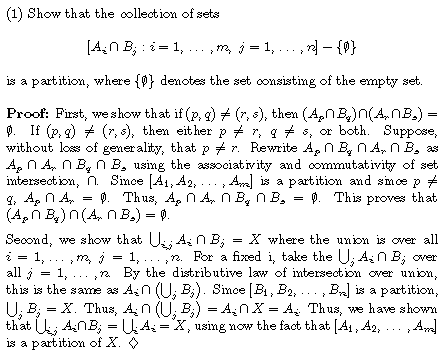
1.26, 1.49, 1.50, 1.51, 1,52, 1.53, 1.55, 1.56, 1.58, 1.59
2.21, 2.29, 2.30, 2.39, 2.42, 2.44, 2.46, 2.60, 2.66, 2.74
Problem 1.26:
(1) If S(n,k) is the number of partitions of n things into k "blocks" or "cells" then S(n,k)=S(n-1,k-1) + kS(n-1,k). Summing over all k, 1<=k<=n, gives B(n), the total number of partitions of n. B(n) is called the the "Bell number" for n. B(4)=15. Why? Be prepared to compute B(5), B(6).
(2) In "two-line" notation, the function
| a | b | c | d |
| 1 | 2 | 2 | 3 |
has domain {a,b,c,d} and image or range {1,2,3}. Once having specified the ordering of the domain (in this case a, b, c, d), we can now specify functions in "one-line" notation. The function above is written (1,2,2,3) in one-line notation. More simply, we just write 1223. We can think of this function as specifying a partition of S={a,b,c,d} as follows: Block 1 is {a}, Block 2 is {b,c}, Block 3 is {d}. Do you see the rule? The partition is the set of blocks {{a}, {b,c}, {d}}. Is this the same as the partition {{b,c}, {a}, {d}}? Here are the fifteen partitions of {a,b,c,d} listed in lexicographic order, one-line notation: 1111, 1112, 1121, 1122, 1123, 1211, 1212, 1213, 1221, 1222, 1223, 1231, 1232, 1233, 1234. What does "lexicographic order" mean here? Why doesn't the function 1311 appear in this list? What is the partition of {a,b,c,d,e,f,g,h} specified by the function 122345316? What is the partition just before this in lex order, just after this?
Problem 1.49:
(1) What about A x A x A where A is the intersecton of B and C? For example, is A x A x A the same as the intersection of
B x B x C with C x C x B with B x C x B?
For A x A when A is the intersection of B, C, and D we can specifiy the pairs to be intersected with the following table:
| B | C | D | |
| B | x | ||
| C | x | ||
| D | x |
This table "stands for" the intersection of (B x C) with (C x D) with (D x B). Is this the same as A x A ?
Problem 1.50:
(1) What if B union C is replaced by B union C union D?
(2) What if B union C is replaced by B intersection C?
Problem 1.51:
(1) For part (vii), use the contrapositive.That is, show that if the intersection of all Ai, i in J, is not empty, then J must be finite. Recall that the contrapositive of X => Y is ~Y => ~X. A statement and its contrapositve are equivalent (proving one, proves the other).
Problem 1.52:
(1) Analogous to Problem 1.26 (2) above, use a function to specify subsets:
| 1 | 2 | 3 | 4 |
| 1 | 0 | 0 | 1 |
This table specifies the subset {1,4}. Now list all such functions in one line notation:
0000, 0001, 0010, 0011, 0100, 0101, 0110, 0111, 1000, 1001, 1010, 1011, 1100, 1101, 1110, 1111.
This gives a listing of all subsets of {1,2,3,4} as binary numbers in increasing size (equivalently in lexicographic order). This is the same as the "power set" {1,2,3,4}. The power set of {1, {1,2}, 4} has eight elements.
Problem 1.53
(1) Let's add a fifth example: {{1,2}, {3,4}, {1,2}, {3,4,5,6}}.
Problem 1.55
Problem 1.56
Problem 1.58
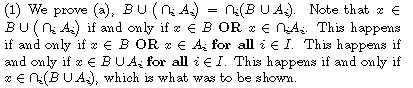
(1) Can you find an algebra of sets with eight elements that is not the power set of U for some U?
Problem 1.59

(2) Suppose instead of taking the intersection of these two sigma-algebras, you take the set of all intersections of pairs of sets, one from one sigma - algebra and one from the other. Is this a sigma-algebra?
Problem 2.21
(i) Using another notation for the binomial coeficient, this is C(12,4).
(ii) Method 1 gives C(10,4) + 2C(10,3). Method 2 gives C(12,4) - C(10,2). Both approaches are useful in general. Note that C(12,4) - C(10,2) = C(11,4) + C(11,3) - C(10,2) = (C(10,4) + C(10,3)) + (C(10,3) + C(10,2)) - C(10,2) = C(10,4) + 2C(10,3). What rule about binomial coefficients are we using here?
(iii) Suppose there are three students, A, B, C, such that when they are all three together there is always trouble. How many ways are there to send the delegation so that there is no trouble (either at home or at the convention)? What if any two of these three cause trouble when together and we don't want any trouble (at home or at the convention)? What if we don't care about trouble at home, but we don't want trouble at the convention?
Problem 2.29
(1) Note that the three permutations come out in dictionary order: abc, acb, bac, bca, cab, cba. Why does this happen (in terms of the tree diagram's structure)? What is the next permutation after cfedba in dicitionary order? What is the permutation just before this one?
Problem 2.30
(1) Similar problems are 2.70, 2.71, and 2.72. Make sure you can do those also.
Problem 2.39
(1) The number of sequences of length r from n things is P(n,r) = n(n-1)(n-2) ... (n-r+1). It is best to reformulate the answers to this problem in terms of P(n,r). For (i), the number of four-letter words from HISTORY is just P(7,4). For (ii), the number of four-letter words from HSTRY (the consonants) is P(5,4). For (iii), there are P(5,2) ways to pick the first and last letters (consonants) and P(5,2) to fill in the remaining two letters, giving P(5,2)P(5,2). For (iv), there are P(2,1) ways to pick the first letter (a vowel) and P(6,3) ways to fill in the rest, for 2P(6,3) ways total. For (v), there are 4 places to put the Y and, for each such choice, P(6,3) ways to fill in the rest for a total of 4P(6,3). For (vi), once T has been placed in the first position, there are P(2,1) choices for the ending vowel and P(5,2) ways to fill in the remaining letters, giving a total of 2P(5,2). For (vii), once T has been placed in the first position, there are 3 places to put the S and then P(5,2) ways to fill in the remaining letters for a total of 3P(5,2). Finally, for (viii), there are P(4,2) positions where the two vowels can be placed in the order first the I and then the O, there are P(5,2) ways to choose the remaining letters for a total of P(4,2)P(5,2). Note that (viii) is a little tricky since P(4,2) is selecting 2-permutation of the places where the letters are to go while P(5,2) refers to 2-permutations of the consonants HSTRY. If the places are 1234 and we choose the two permutation 41 then the word will look like O - - I. If we choose 14 then the word will look like I - - O.
(2) Problems 2.45 and 2.47 are variations on this type of problem.
Problem 2.42
(1) There are two patterns BGBGBGBG, GBGBGBGB. For each pattern there are P(4,4) = 4! arrangements for each sex, giving 2P(4,4)P(4,4) for part (i). For (ii), if B1 and G1 are two sit together, there are seven positions in each pattern where they can be seated. Once seated, there are P(3,3) ways seat the remaining boys and P(3,3) ways to seat the remaining girls. The answer is 2x7xP(3,3)xP(3,3). The answer to (iii) is (i) - (ii).
(2) Problem 2.43 is an important variation of this problem. There are two methods. The first is to choose one person and place that person, say B1, in the same seat in the circular table in all seatings. The remaining problem is to place the rest going around the table in a clockwise manner from B1. This problem is just like Problem 2.42 and doesn't involve circular arrangements. Thus for part (i) the answer is P(3,3)P(4,4) = 3! 4!. For (ii), it suffices to choose B1 and G1 as the two to sit together (why? remember that B1 was the one who always got the special seat). G1 can go to the right or to the left of B1. In either case, there are P(3,3)P(3,3) ways to seat the remaining three boys and three girls, giving a total of 2xP(3,3)xP(3,3). Again, the answer to (iii) is (i) - (ii). The second method often used is to divide the answers of problems like Problem 2.42 by 8, the number of ways to turn the table without rearranging the seating. You have to be careful about the second method. It is best to use both methods and check them against each other. Here is why. Dividing the answer to Problem 2.43(i) by 8 gives the correct answer to Problem 2.43(i), but gives the wrong answer to Problem 2.43(ii). Do you see what goes wrong?
Problem 2.44
(1) Here is a variation of Problem 2.44. Suppose the balls consist of four blue (B), four red (R), and two green (G). They are also numbered 1, ... 10 with removable tags. How many of the ordered samples of size 3 result in the pattern BBR if the sampling is done with replacement? Without replacement? How many of the samples of size four have all three colors present when sampling is done with replacement? Without replacement? How many distinct patterns BBR, BGR, etc., can occur if sampling is done with replacement? Without replacement? If three balls are selected and the tags removed which of these patterns is "most likely" to occur if sampling is done with replacement? Without replacement?
Problem 2.46
(1) Notice how the order in which the restrictions are considered here makes the problem easier. For example, if the digits are labled first, second, third fromleft to right, in (ii) it is best to consider first the restriction on the third digit (there are 5 choices), then the restriction on the first (8 choices, excluding the choice for the third digit and the fact that 0 can't be the first digit), then the restriction on the second digit (it can't be the first or the third, making 8 choices). Total 8x8x5. The same pattern of restrictions is best for (iv).
(2) A variation is to consider three digit numbers with two distinct digits (e.g., 232).
Problem 2.60
(1) An obvious variation is to do a similar thing for six-letter words with, for example, two vowels and four consonants.
(2) If the 1,596,000 words of (i) are listed in dictionary order, which word is in position 798,001 (i.e., the first word of the second half of the list)? This will not be on a quiz or the final, but you might have fun thinking about it.
Problem 2.66
(1) Shouldn't the text say whether they want ordered or unordered partitions? The answer on page 36 is for unordered partitions. Multiply by 2 to get ordered partitions (2^n-2).
(2) What about ordered partitions of n into three nonempty blocks?
Problem 2.74
(1) A useful technique on this type of problem is to break it down into subproblems in some way. In this case, count how many terminal paths there are that involve 6, 5, 4, 3, 2, 1, 0 boundary edges, after XR, before using a non-boundary edge. For example, (XR)ABCTZYS has six boundary edges before the first non-boundary edge YS is used. There is only 1 such path. For 2 boundary edges there are three paths: (XR)ABSTC, (XR)ABSTZY, (XR)ABSTYZ. The number of such paths corresponding to the boundary edge indices 6, 5, 4, 3, 2, 1, 0 are 1, 0, 1, 0, 3, 0, 5. Thus there are ten total paths.